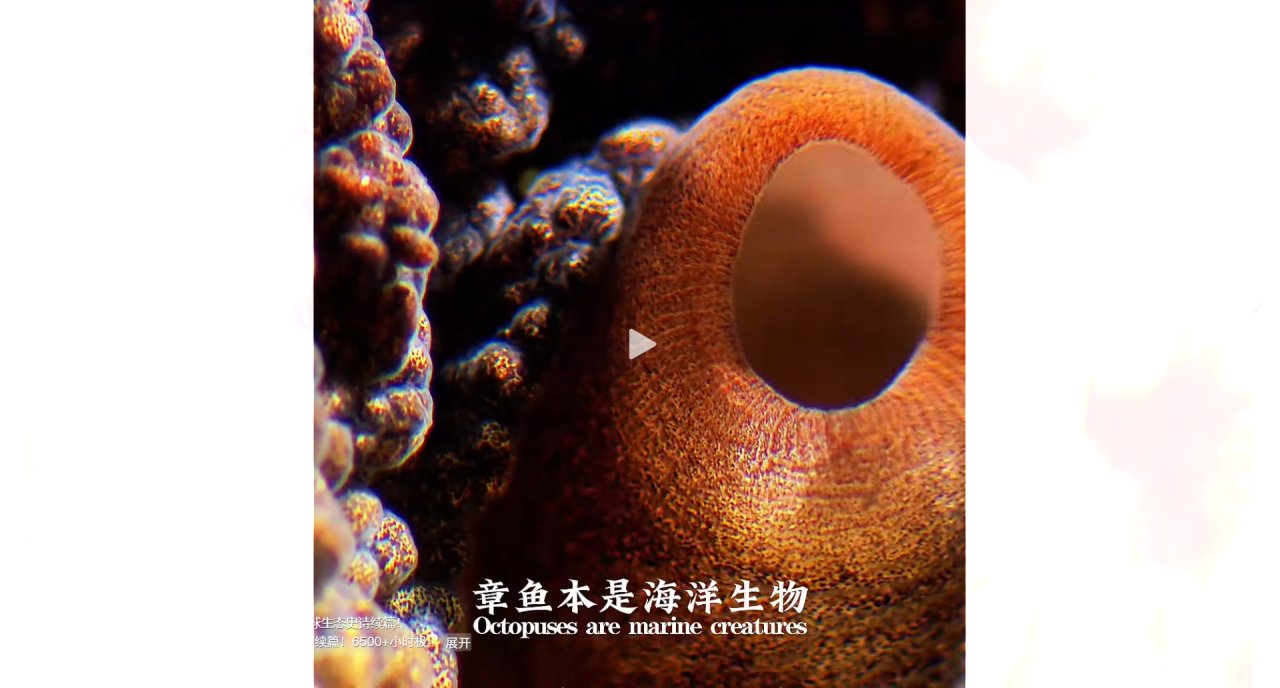
The video paused on a frame that looked less like biology and more like a glitch in reality. It was an extreme close-up of an octopus’s eye, the iris a ring of copper-orange fiber texture, dense as polished metal or rough leather. In the center sat a dark, horizontal slit pupil, calm and deep, staring directly at the viewer. To the left, the suckers on the arm blurred into purple-black bumps, edged with a strange blue-magenta chromatic aberration that made the whole image feel hallucinatory.
I watched my kid lean forward until his nose nearly touched the phone. He didn’t say “cool.” He didn’t ask if it was real. He just pointed at the white subtitle text floating over the black background: “Octopuses are marine creatures.” Then he tapped the screen, trying to zoom in further, frustrated that the pixels wouldn’t resolve any finer detail than what the camera had already captured. The scene was vivid, but the interface was flat. We were looking at a picture of a thing, not the thing itself.
What Parents Actually Say
Later, I read through the comments section. One parent wrote, “How do they manage to get such close, clear shots?” Another confessed, “Octopuses look so ugly... I’m afraid of soft things.” A third asked, “Do crabs have hearing?” These weren’t rhetorical questions; they were genuine gaps in understanding, filled by awe or aversion. The fear of mollusks is common enough that it has its own name, malacophobia, though most kids just call it “the ick.”
We tend to think science education fails when we don’t have answers. But often, it fails because we don’t have the right kind of question. When a child sees that copper eye, the impulse isn’t to memorize taxonomy. It’s to understand why the pupil is horizontal, why the skin ripples, why the light bends into those purple halos. Those are optical and biological mechanisms, but they start as visual puzzles.
Seeing Without Glassware
This is where Wwai comes in, not as a replacement for the documentary, but as a way to keep the looking going after the video ends. My son opened the app himself. There was no fragile glass slide to break, no chemical smell to worry about. He selected a specimen from the library—a simple pond water sample—and the AI tutor walked him through what appeared on the simulated field of view.
He asked why the paramecia moved in spirals. The tutor explained the cilia beating in coordinated waves, something too fast for the naked eye to track without magnification. When he asked about the color of the cell walls, the AI admitted it couldn’t show true color in the simulation, only structural contrast. My son checked the conclusion against a diagram in the app. He wasn’t passive. He was verifying.
The Mechanism Behind the Glow
Let’s go back to that octopus eye. Why did it look so alien? The horizontal pupil is an adaptation. Octopuses live on the seafloor, where light comes from above. A horizontal slit allows them to see clearly across the horizon while blocking out glare from the surface. The copper-orange iris isn’t pigment in the way human eyes use melanin; it’s structural color, created by microscopic layers that reflect specific wavelengths of light.
And those purple edges? That’s chromatic aberration, a lens imperfection. High-resolution macro lenses struggle to focus all colors at the same point. Blue light bends differently than red light. In the video, this technical flaw became an aesthetic feature, making the creature look otherworldly. At home, we can’t replicate the depth of the ocean, but we can replicate the principle of refraction using a drop of water on a leaf under a magnifying glass.
Try This With a Leaf
Take a broad leaf, like spinach or basil, and place a single drop of water on its surface. Look through the drop with your phone’s camera set to macro mode, or simply squint through it. You’ll see the veins swell and darken. The water acts as a convex lens, magnifying the chloroplasts—the green factories inside the cells. You won’t see individual organelles without proper equipment, but you will see the structure shift. It’s a small, safe experiment that mirrors the scale-jump from naked eye to microscope.
Curiosity Is Not Linear
There’s a temptation to organize these moments into lessons. We want the kid to learn the binomial name, *Octopus vulgaris*, and move on. But curiosity doesn’t work that way. It circles. One comment noted, “Watching this episode while taking a poop is relaxing.” Another said, “But it’s delicious, really tasty.” These reactions aren’t distractions; they’re connections. Science lives in the overlap between fear, appetite, and wonder.
When my son finished with the app, he didn’t summarize what he learned. He went to the kitchen and asked if we had any calamari rings frozen. He wanted to look at the texture again, this time with a hand lens, comparing the dead tissue to the living simulation. It wasn’t a breakthrough. It was just Tuesday afternoon.
The eye on the screen stays with you, not because it taught you everything, but because it showed you how much you hadn’t seen yet.