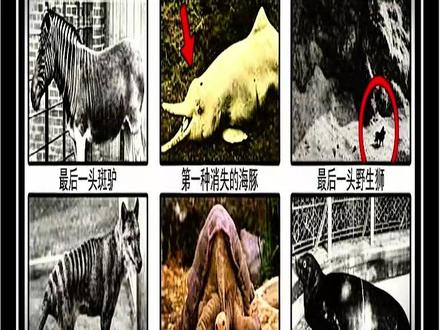
A video cataloging the "final images left behind" by nine extinct animals has a quiet comment section, but its top comment (15 likes) asks an oddball question: "How many pronunciations of bái-jì-tún (白暨豚, the Yangtze river dolphin) appear in this video?" Behind the joke sits an awkward fact: most people have only ever met this name inside the four characters "already extinct." Another comment (2 likes) cuts deeper: "Why is there only extinction, never new life?"
Those two comments frame this piece's main point: **footage is a species' last sound. Remembering them isn't sentimentality — it's how we keep the next name off the list.**
Ten surviving thylacine clips, and you can only watch fewer
The heaviest footage in the video (as presented) concerns the thylacine. The subtitles supply the detail: in the 1930s, a man named Elias Churchill trapped a thylacine in southern Tasmania with a snare. And by the video's account, only ten thylacine film clips survive — the longest just a few minutes.
The thylacine has been widely considered extinct since 1936. All of humanity's moving impressions of this species add up to under fifteen minutes. **Hundreds of thousands of years of evolution, compressed into a few strips of black-and-white film — that is the weight of the words "last footage."**
"Why is there only extinction, never new life?"
The comment is blunt, but deserves a serious answer. New life does exist: scientists describe new species every year, mostly among insects, the deep sea, and microbes. The problem is speed. By the 2019 assessment of IPBES, the UN biodiversity platform, roughly one million species face extinction threats driven by human activity. New species "come on the shelves" far too slowly to offset old ones going off.
So the answer isn't "no new life" — it's that **human activity has pushed the extinction rate above the natural background level; new accounts can't be opened fast enough as the old ones turn, page by page.**
Most names on the extinction list carry a human signature
Reviewing recent extinctions, overhunting, habitat destruction, and invasive species run through nearly every case. This isn't coincidence. Two news items this November read like the list's "present tense":
- Reporting from the COP31 China pavilion side event (China News Service, Nov 10): Guangxi's ecology and environment director stated that the eastern black-crested gibbon, once believed extinct, was rediscovered on the China–Vietnam border in 2006 with just 3 groups and 19 individuals — now 11 groups and 74 worldwide, a case pulled back from the list's edge;
- Per Tencent News (Nov 14), Victoria, Australia's state faunal emblem, the Leadbeater's possum, has had its last known wild lowland individuals moved out of the Yellingbo reserve — the lowland population is now empty in the wild, pushed by roughly one million feral deer plus feral cats and foxes.
One recovery, one loss — the same human variable signs both lists: **human activity can sign the extinction list or the recovery list.**
What should kids actually watch for in this footage?
Not just "how sad." The real lesson is method: how do scientists reconstruct a species' history from a strip of film, a specimen, a patch of remnant habitat? How do they estimate population size from scattered sighting records? That craft is essentially a lesson in evidence — it teaches you not to trust rumors (claims that "someone saw a thylacine" have never been verified), only records that survive scrutiny.
That evidence-only discipline is itself a gift to children. More important than remembering nine sad names is remembering how scientists treated those nine names: verified one by one, documented, written into assessments.