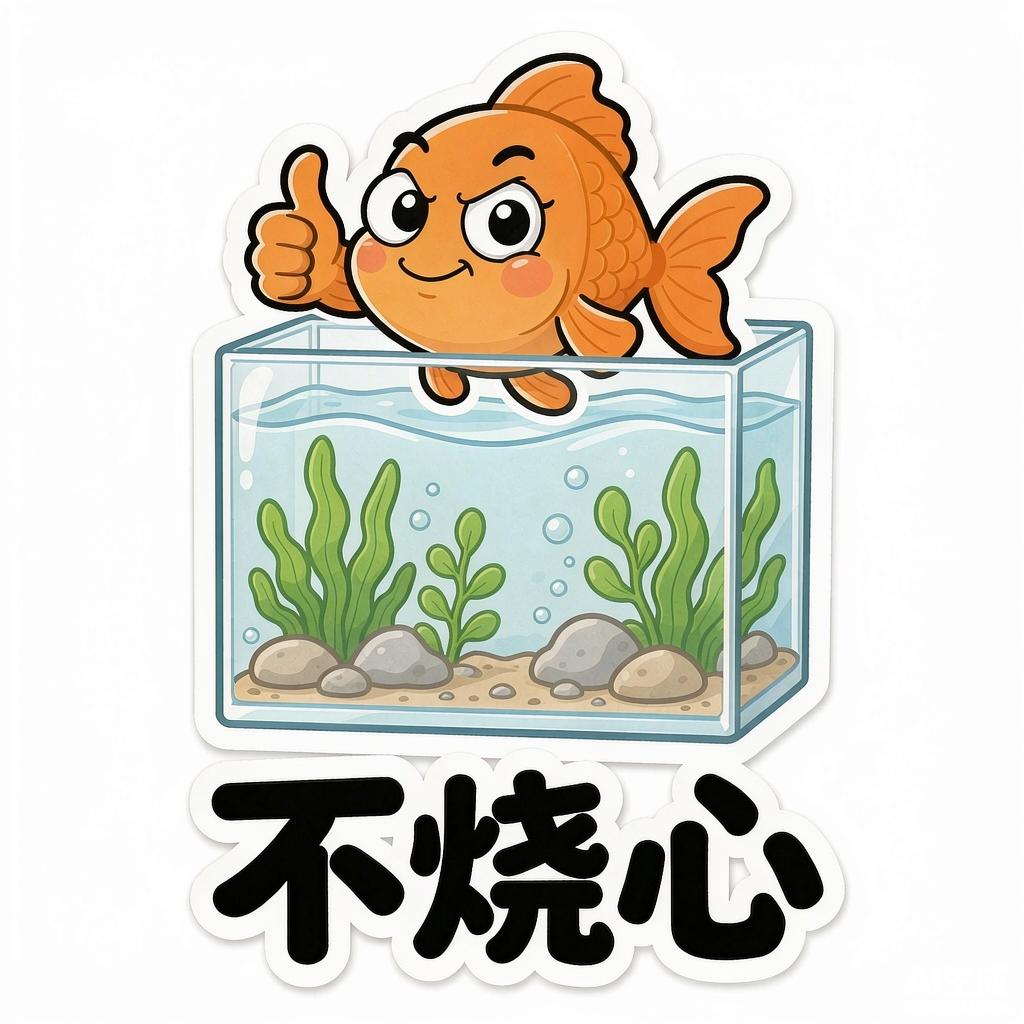
An aquascaper tore down his entire planted tank setup — a full ADA arrangement that commenters pegged at "no less than 100,000 yuan" (about $14,000). The video title is honest about the pain: "This money burns! Full tear-down and reset, clearing to factory settings this episode." The comment section's first reaction was aesthetic judgment — "A full ADA setup stocked with black-tail tetras is a waste" (8 likes). The second comment guessed the price: "A setup like that costs a good hundred grand." The creator replied: "Conservative. Didn't stay under 100k."
The title's "burns" (烧心) collides head-on with late-2026's top meme "不烧心" (bù shāo xīn — slang for something trustworthy). Per Wenhui Daily (Nov 6), the Douyin hashtag #不烧心 has passed 5.5 billion views. **Meme aside: a rescape isn't failure — daring to clear a $14K tank and start over is the entry threshold of understanding a planted ecosystem.**
A rescape isn't an accident; it's the system's rejection response
Outsiders see broken equipment; insiders see system-level problems. A planted tank is a miniature ecosystem: substrate, water column, light, CO2, the bio-load of fish, shrimp and snails — everything interlocks. Any long-term imbalance — nutrient excess, runaway algae, aging substrate — pushes the system into a decline that's often unrecoverable.
Clearing everything sounds brutal, but it's zeroing the system to retune it from scratch — what the title calls "factory settings." **What you buy isn't a pile of equipment; it's a small world that needs continuous operations — and a rescape is operations failure at its highest form.**
"Just toss the tank and buy a new one" — and why that's an outsider's line
One commenter said: "Just throw the tank away and buy a new one — cheaper." The line exposes a common misreading: the belief that what gets torn down is the tank.
The glass never breaks. What gets torn down is the imbalanced ecology inside — the substrate replaced, the plants replanted, the water parameters retuned. Tossing the glass for a new tank is like buying a new monitor because your computer has a virus. **People who understand ecosystems rescape the system; people who don't only see the container.**
Mistakes are the curriculum: a rescape is the cheapest science class
This autumn, Beijing's compulsory-education schools fully launched the "Learning by Doing" (做中学) flagship program. Per Global Times Network's report (Nov 1), students in grades 4–9 must complete at least one scientific inquiry task per semester, no fewer than four class hours; commentators have summarized the orientation in six characters — "reality-driven, mistakes as the norm."
Those six characters are the pedagogy of a rescape. A child keeping a planted tank watches the system fall out of balance, attempts rescue, and starts over — an experience of "starting from real problems, treating failure as routine" worth more than any class spent memorizing definitions of "ecosystem." And a tank costs far less than a lab: a small tank, a few plants, a box of test strips turn abstractions like "controlled variables" and "system feedback" into visible algae blooms and water swings.
Three things to know before starting your first tank
- **Budget for a rescape**: tear-downs are recurring operating costs, not accidents;
- **Learn the system before buying gear**: without understanding light, nutrients and bio-load, expensive equipment won't save a bad system;
- **Failure logs beat success photos**: how you handled each water swing and algae bloom is the real harvest.
"This money burns" is self-mockery; "a bit pricey, but it doesn't burn" is the internet's highest praise for reliability in 2026 (meme context per Wenhui Daily, Nov 6). Daring to clear a $14K tank isn't about money — it's systems thinking that treats failure as routine. The real threshold of a planted tank was never the price tag; it's the courage to start over — the same lesson science education most wants to teach.
**FAQ: What does "rescape" (翻缸) mean?**
Clearing and resetting a planted tank entirely: replacing substrate, replanting, retuning water — a "factory reset" for an imbalanced miniature ecosystem.
**FAQ: How much does a beginner's first planted tank cost?**
The range is huge — from a few hundred yuan to five-figure ADA setups. The key is reserving room in the budget for maintenance and resets, not maxing out on gear up front.