In 2000, a paper appeared in Nature under a heading that most editors would have avoided: Intelligence. The subject was a bright yellow slime mould called Physarum polycephalum, an organism with no neurons, no brain and no body plan to speak of. Nakagaki, Yamada and Tóth had put it in a small plastic labyrinth with food at two points. It filled every corridor, then withdrew from the dead ends until a single thick tube connected the food by the shortest available route. Twenty-six years later, researchers are still arguing about what that result means, and the argument is more interesting than the answer.
One cell, thousands of nuclei
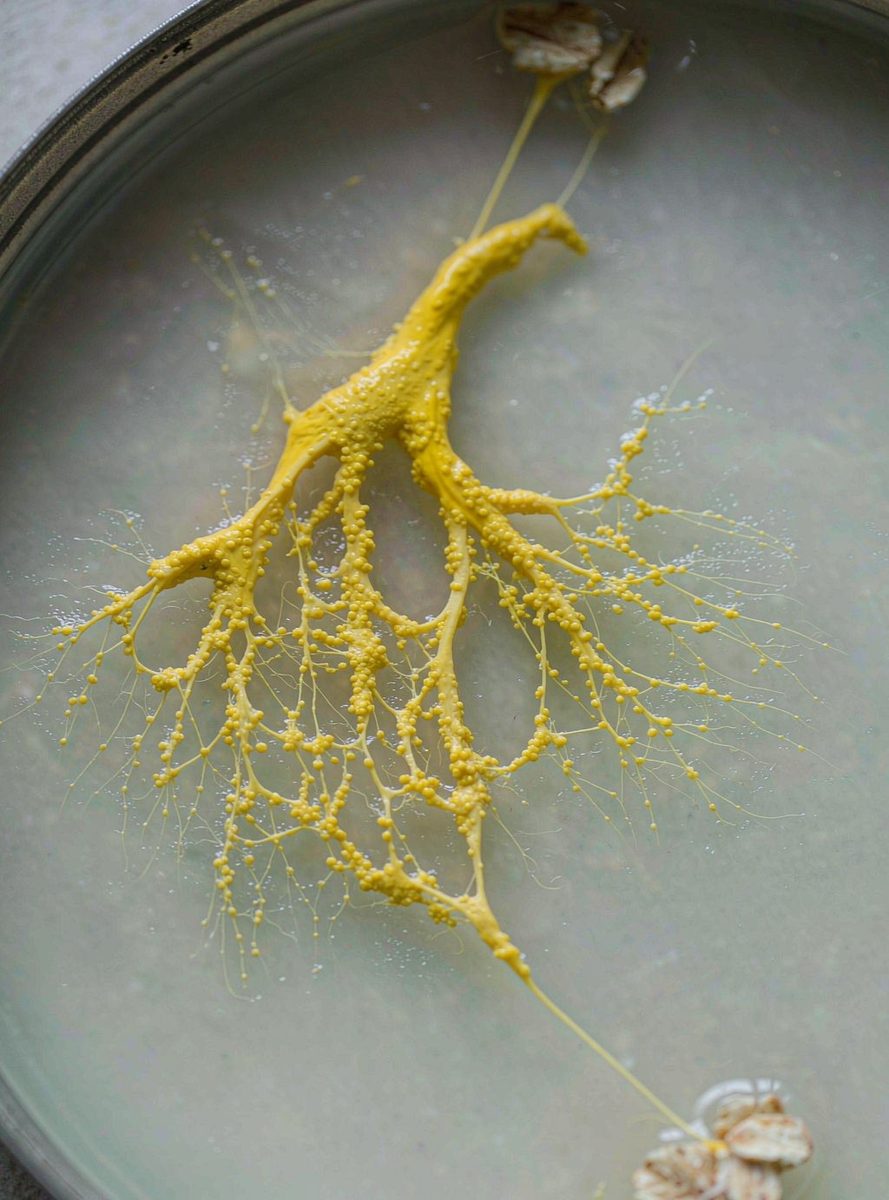
The first thing to get straight is what the organism is. During its feeding stage, Physarum exists as a plasmodium: one continuous cell, bounded by a single membrane, containing thousands of nuclei that divide in synchrony. It is not a colony of cells cooperating. It is one cell that has refused to divide its cytoplasm, and it can grow to the size of a dinner plate, or larger.
Inside that cell runs a network of tubular veins. Cytoplasm streams back and forth through them at up to about 1.35 millimetres per second, reversing direction roughly every minute or two. The flow is driven by rhythmic contractions of an actomyosin cortex, the same proteins that contract a muscle, deployed without any muscle. Where flow is heavy the vein widens; where flow is thin the vein narrows and eventually collapses. That single feedback rule — reinforce what carries traffic, prune what does not — turns out to be enough to solve a surprising number of problems.
The maze, and the number that gets misquoted
In the original experiment, fragments of plasmodium were placed in a maze and allowed to fuse into a single sheet that spread through every passage. Food was placed at the entrance and the exit. Over hours, the organism retracted from the corridors that led nowhere and thickened the tube along the shorter of the two routes. In the paper's own comparison, that route was about 22 percent shorter than the alternative — a figure specific to those two paths in that experiment, not a general claim about how much shorter slime mould routes are.
That distinction matters, because the popular retelling usually drops it. The organism did not survey the maze, represent it, and then choose. It explored everything, and the geometry of flow did the selecting. The result is adaptive without being deliberate, which is exactly the phenomenon that makes the case worth teaching.
The Tokyo map
A decade later, a team led by Atsushi Tero went bigger. They placed 36 oat flakes on agar at positions corresponding to Tokyo and the surrounding cities in the greater metropolitan rail network, then set the plasmodium down at the point representing Tokyo. The organism spread across the plate, connected the food sources, and pruned. The network left behind was compared with the actual railway system, and the paper, published in Science in 2010, reported comparable values for total length, for average distance between points, and for how well the network tolerated a random break.
The details of the setup are the interesting part. The mould had no map. Geography was imposed on it from outside: bright light repelled the organism, so the team used illumination to mark the sea, the lakes and the mountains, leaving only habitable land open to exploration. The routing — the expensive part, the part engineers argue over for a decade — was the organism's contribution. The team turned the behaviour into a model, showed it could generate similar networks to order, and collected an Ig Nobel Prize in transportation planning the same year.
sans-serif;font-size:20px;font-style:normal;font-variant-caps:normal;font-variant-ligatures:normal;letter-spacing:normal;line-height:1.55;margin:30px 0px 12px;orphans:2;text-align:start;text-decoration-color:initial;text-decoration-style:initial;text-decoration-thickness:initial;text-indent:0px;text-transform:none;white-space:normal;widows:2;word-spacing:0px;" data-page-node-id="haWfsqBeLkyAgtAEcPAoRf" data-dm-ref="19">2026: it is fluid mechanics, not thought
This year brought a result that reframes the whole picture. Lisa Schick and colleagues, working with Karen Alim's group at the Technical University of Munich, published in PRX Life a study of how the plasmodium escapes confinement. They trapped starving slime moulds inside shapes drawn with blue light at 470 nanometres, a wavelength the organism strongly avoids, and watched it try to get out.
The escapes were not random and not simply the shortest path. Regardless of whether the trap was a triangle, a square or a hexagon, the mould escaped along the longest axis of the shape. The mechanism was peristalsis: the rhythmic contraction waves that pump fluid through the veins gradually reorganised until they were aligned with that axis, where they could build the most pressure and push the most mass outward in one surge. Before that alignment, the organism put out small protrusions almost everywhere along the boundary. Only harsh confinement, the authors note, drove it to settle on the transport mode that worked.
That is a very different kind of explanation from "the slime mould decided." The decision is real in the sense that behaviour changed adaptively. The machinery behind it is a fluid system finding the configuration that moves mass most efficiently, and the finding is measurable in the flow patterns rather than inferred from the outcome.
What the microscope shows
Physarum is unusually generous to a student with a lens. A wet mount of a plasmodium shows the veins as clear channels with granular cytoplasm streaming through them, and at low magnification you can watch the direction reverse. The shuttle streaming is visible in real time, which is rare: most cellular processes need time-lapse or an electron microscope to become legible.
Staining brings out the nuclei, which sit in the streaming cytoplasm in enormous numbers, and the rhythmic contractions become visible as waves of thickness moving along a vein. Compare that with a section of true muscle and the difference is instructive: the same contractile proteins, arranged without cells, doing work in a single compartment. Physarum is also easy to culture, which is why it appears in school labs as a model for network behaviour and, more recently, as a template for algorithms.
The definition fight
Whether any of this counts as intelligence has been contested for more than twenty years, and the disagreement is productive rather than petty. One camp points to maze solving, route optimisation and habituation — moulds trained to cross a bitter bridge eventually stop minding it, and a habituated individual can pass the tolerance on when it fuses with a naive one. Another camp argues that using the word intelligence here is a category error dressed up for press coverage, and that flow-based explanations are both sufficient and more honest.
For a biology class, the fight is the lesson. A behaviour can be adaptive, reproducible and quantitatively impressive while the mechanism turns out to be physics rather than computation. Students are usually taught to explain behaviour by finding the organ that produces it. Physarum has no organ. What it has is a plumbing problem, solved by the same rule that governs traffic in a city: use it or lose it.

If you want a closer look at organisms like this one, Wwai pairs real scanned specimens with an AI lab partner that can walk through the sections with you — the kind of thing that turns a reading assignment into a bench session.