In the middle of the Second World War, sonar operators in the Pacific kept finding bottom where there should have been deep water. The echo was strong, it looked like the seafloor on the trace, and it moved: up at dusk, down at dawn, sometimes several hundred metres. For a while the readings were treated as a possible submarine contact. They were not. The bottom they were pinging was alive.
That false bottom is now called the deep scattering layer, and it is one of the largest biological features on the planet. It is also the first thing most students should learn about the ocean that is not on any map, because it explains where a very large fraction of the ocean's animals spend their day.
What the sonar was hitting
Sound travels well in seawater until it meets a change in density. A fish with a gas-filled swim bladder is almost a perfect reflector at the frequencies used by mid-century echo sounders, and a layer of them a few tens of metres thick returns an echo indistinguishable from a hard bottom.
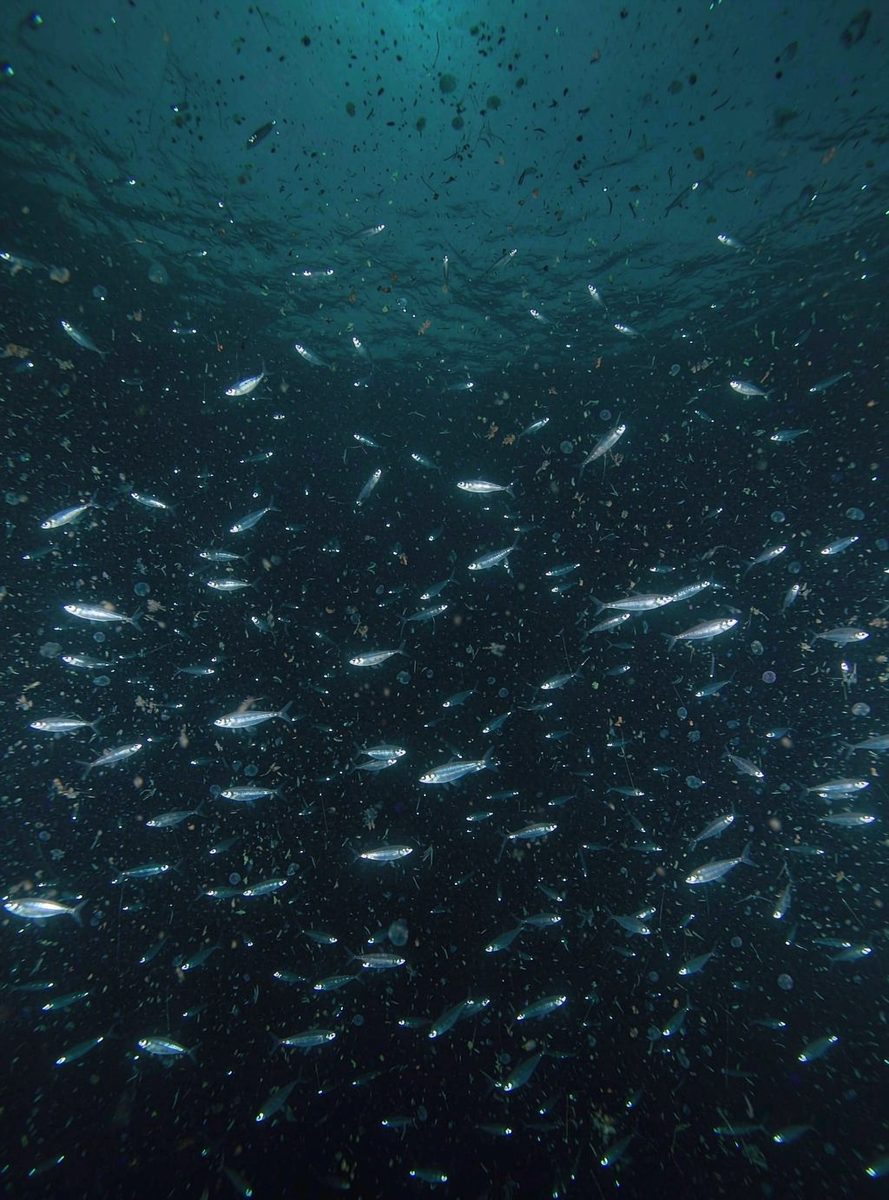
The organisms in the layer are mostly small: lanternfish a few centimetres long, krill, copepods, squid, and a wide assortment of gelatinous animals that reflect poorly but are present in enormous numbers. Lanternfish alone are thought to make up a large share of the deep scattering layer in many regions, and the mesopelagic zone they inhabit, roughly 200 to 1000 metres down, is estimated to hold the majority of the ocean's fish biomass.
The layer is not a wall. It is a concentration, and it is patchy, and parts of it do not migrate at all.
A commute measured in hundreds of metres
The migration itself is straightforward to describe and hard to explain. At dusk the animals rise from the twilight zone toward the surface, often into the top hundred metres. At dawn they descend again. Typical amplitudes are in the range of several hundred metres, and in some places animals travel close to a kilometre each way.
The cue is light. The layer tends to follow a particular isolume, a depth where the intensity of sunlight matches a threshold, which is why it tracks cloud cover, and why a solar eclipse can trigger a migration in the middle of the day. Circadian clocks contribute as well, since animals held in constant darkness still show rhythmic vertical movement.
There are variations. Some species migrate in reverse, rising at dawn and descending at dusk. Some make two trips in a day. In the Arctic summer, when the sun does not set, the migration can disappear entirely, which is a strong argument for light as the proximate trigger rather than an internal schedule alone.
The trade-off, and the argument about it
The standard explanation is a compromise between two needs. Food is at the surface, where phytoplankton grow and where zooplankton graze. Predators that hunt by sight are also at the surface, and during the day they can see a small animal against a bright background.
So the animal feeds at night in the dark and retreats during the day to water where the light is too dim for a fish to pick it out. The cost is the swim itself, which for a copepod a few millimetres long is equivalent, in body lengths per day, to an animal of our size running a marathon. The benefit is not being eaten.
A second hypothesis concerns energy rather than risk: feed in warm surface water where digestion is fast, then descend to cold water where metabolism is slow, and get more growth per meal. The problem for that idea is that in some places, including parts of the Antarctic, the water column is nearly isothermal and the migration continues anyway, which points back to visual predators as the main driver.
Both may be operating, in different species and different oceans. The literature is not settled, and the honest way to teach it is as a trade-off with a dominant factor rather than a solved equation.
The part that affects the climate
Every night, animals eat at the surface and every day they digest at depth, and they excrete there. Carbon that was fixed by phytoplankton near the light is therefore transported downward in swimming bodies rather than only in sinking particles. Some of it sinks further, some is respired at depth, and a fraction reaches the seafloor.
This active transport is part of the biological pump, the process that keeps carbon out of the atmosphere for centuries. In the upper water column, passive sinking dominates. At mid-depths, the active and passive components are thought to be comparable in magnitude, which is a way of saying that a great deal of the ocean's carbon flux is being carried by animals small enough to hold in a teaspoon.
The numbers carry large uncertainties, and estimates of mesopelagic biomass have been revised repeatedly. That is worth saying plainly, because the migration is often presented with a confident tonnage attached. The phenomenon is certain. The budget is not.
How anyone knows
The instruments are unglamorous. An echosounder pointed at the water column produces a trace in which the layer appears as a band of backscatter, and following that band through a day gives the migration. Nets towed at different depths give species composition, though the fast swimmers avoid them. Acoustic Doppler instruments and cameras on profilers fill in the gaps.
Under a microscope, a single copepod from a night tow is a lesson in miniature engineering: a segmented body, a pair of long antennae used for swimming, a gut that may be full of dark phytoplankton, and often a visible oil sac whose size indicates how much energy the animal is carrying. The whole migration is written into that sac and that gut, in the difference between an animal caught at midnight near the surface and one caught at noon at four hundred metres.
If you want to examine the animals behind that false bottom rather than the trace on a screen, Wwai pairs a scanned slide library with an AI lab partner, so plankton samples can be worked through at high magnification.
