The image is hard to resist: trees plugged into a fungal internet, old mothers routing sugar to shaded seedlings, warnings travelling through the soil ahead of an insect attack. Parts of that image are solid science. Parts are a story that outran the data, and the distance between the two is one of the most useful things a biology class can examine.
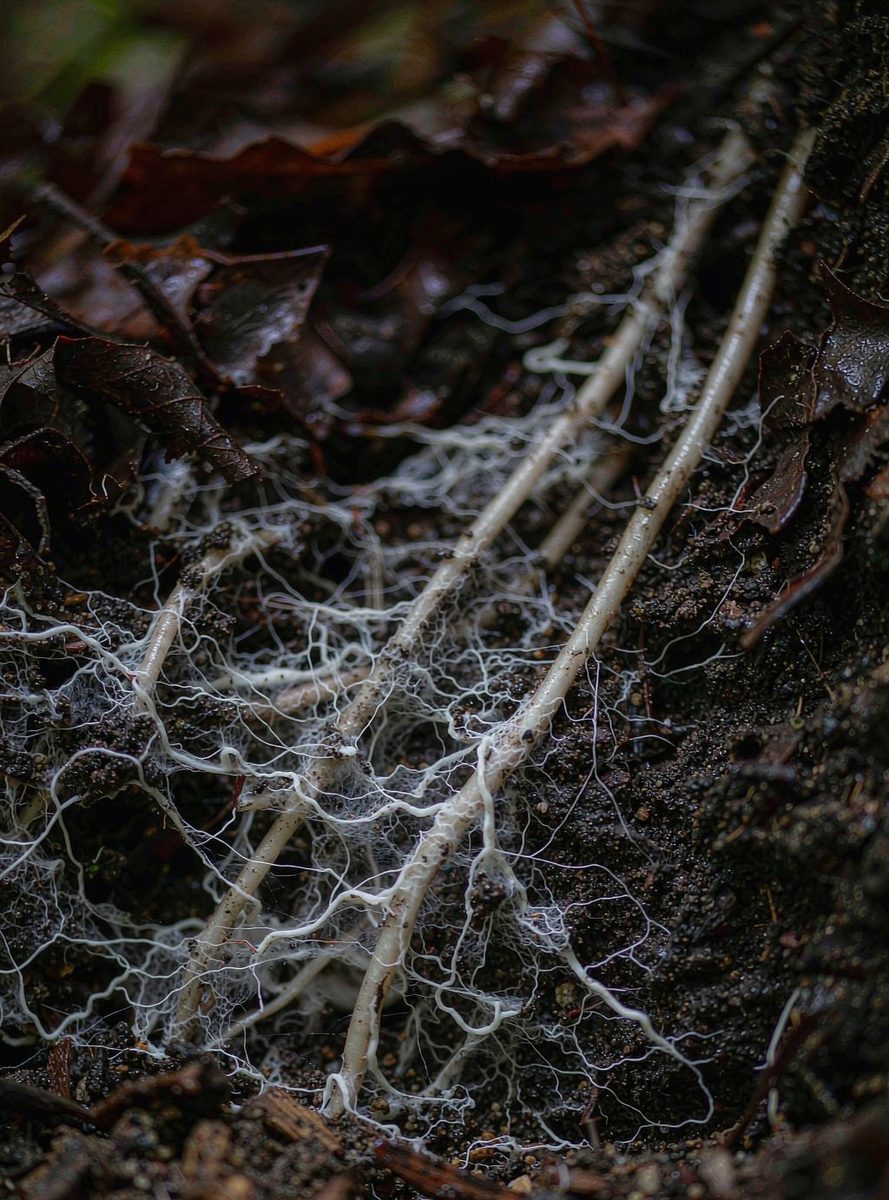
What a mycorrhiza actually is
A mycorrhiza is not a root and not a fungus. It is the interface between them. Fungal filaments colonise a plant's fine roots, and the two organisms exchange materials across a membrane boundary that both of them build.
The most widespread arrangement is arbuscular mycorrhiza, found in the majority of land plants, including most grasses, herbs and crops. The fungus does not wrap the root; it grows between cortical cells and then pushes branched, tree-shaped structures called arbuscules inside them. Each arbuscule is enclosed by an invagination of the plant's own plasma membrane, so neither partner ever opens the other's cytoplasm. The exchange surface is enormous and entirely extracellular, which is a neat trick for a structure that looks invasive.
The other major type, ectomycorrhiza, is the one most people have seen without knowing it: a fungal sheath around the root tip, with hyphae running between cells as the Hartig net. Ectomycorrhizal fungi partner with a small minority of plant species, but those species dominate many temperate and boreal forests, which is why the type feels more common than its species count suggests.
The trade is real and it is regulated
The fungal side of the bargain is reach. A root depletes phosphate in the soil immediately around it, and phosphate moves slowly, so the depleted zone becomes a barrier. Hyphae are finer than roots and can grow past it, into soil pores a root cannot enter, and deliver phosphate back to the interface.
The plant side is carbon. Hosts hand over something in the range of ten to twenty percent of the carbon they fix, which is a substantial subsidy. In return, published measurements put fungal contribution to plant phosphorus as high as ninety percent and nitrogen as high as eighty percent in some systems. Those figures are frequently repeated as if they were constants. They are not; they are outcomes from particular experiments, and the share varies with soil, species and season.
What is genuinely elegant is the control. Phosphate starvation in the plant switches on a signalling cascade that permits colonisation; when phosphorus is plentiful, the same pathway shuts colonisation down. A heavily fertilised field therefore gets less from its fungi, not more, because the plant stops paying for a service it no longer needs.
Where the story went wrong
In 2023, three ecologists published a review in Nature Ecology & Evolution that examined the popular claims attached to these networks. They looked at 593 papers on network structure and 1,083 on function, and at how the field's most cited early papers were being quoted.
Three claims came out badly. That common mycorrhizal networks are widespread across forests: under-sampled, with too few forests actually mapped. That mature trees transfer resources through the network to seedlings and improve their survival: field results were mixed, most reported neutral effects, and direct soil pathways had not been excluded. That trees send warning signals to their offspring through the network: no peer-reviewed field study supported it.
