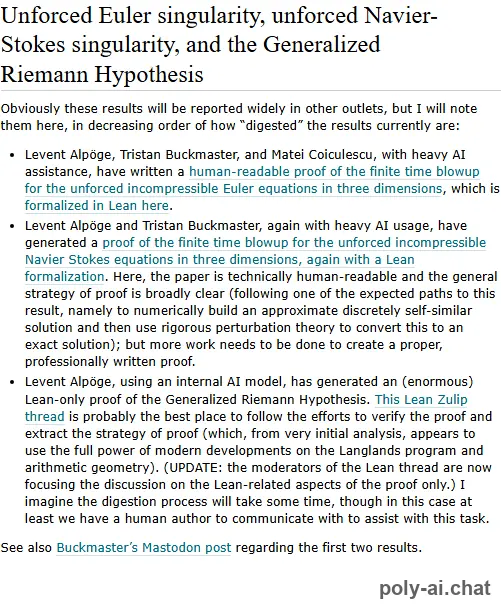
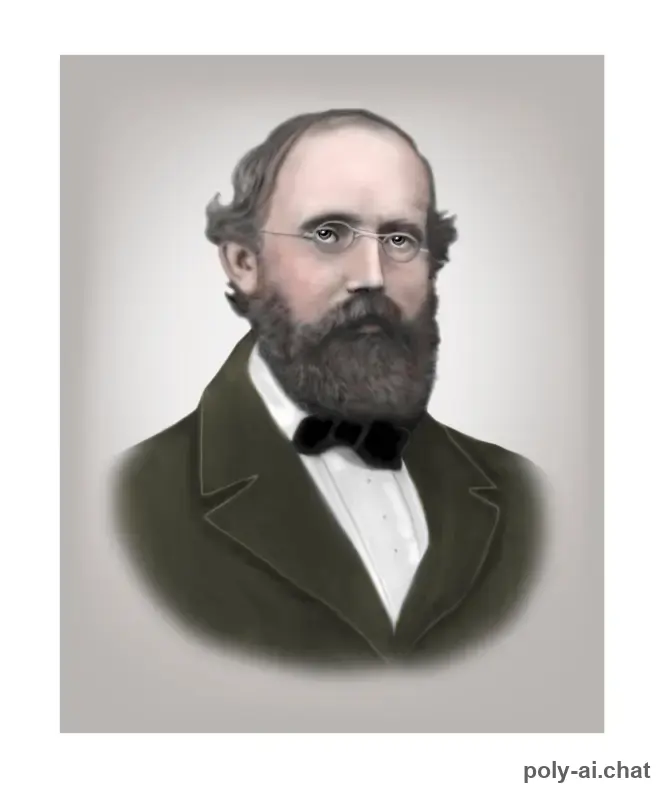
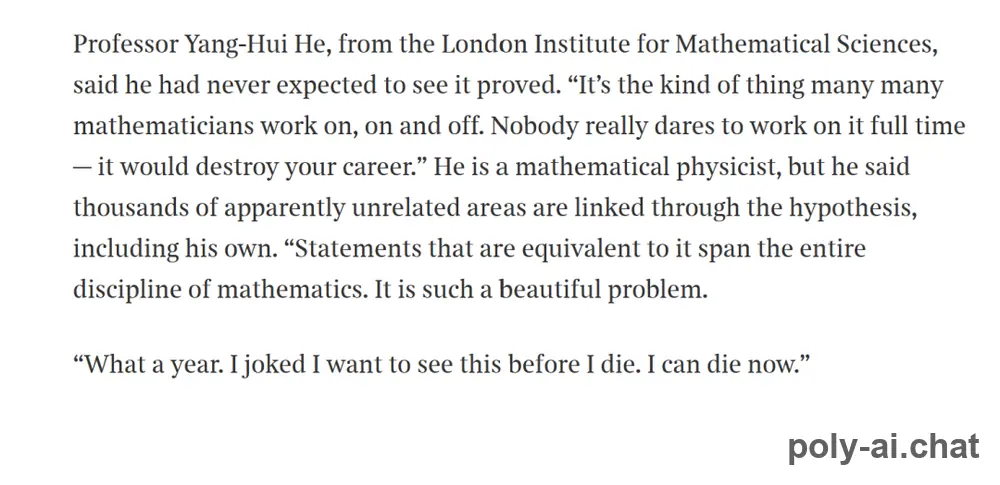
It just happened. The second proof of the Riemann hypothesis is out.
November 20, 2026 is a day that will go into the history books.
On that single day, the world's mathematics community received two manuscripts, both claiming to have conquered the generalized Riemann hypothesis.
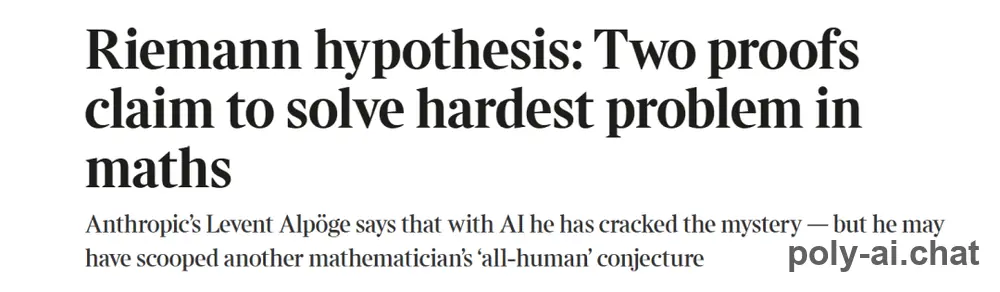
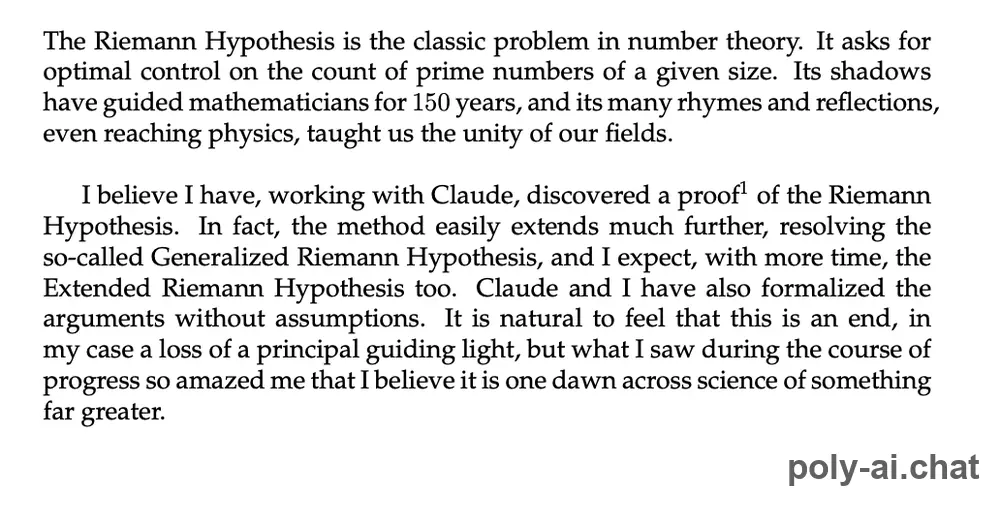
First, Levent Alpöge, a mathematician at Anthropic, released a proof made with Claude, accompanied by Lean formalization code.
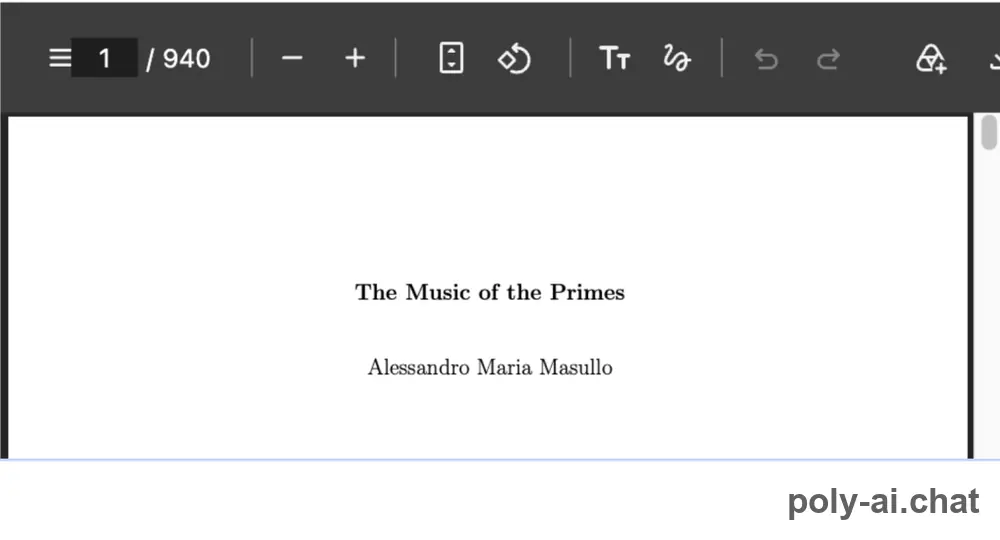
Only a few hours later, Ravi Vakil, president of the American Mathematical Society, posted a blog entry releasing to the world a 940-page magnum opus written by Stanford PhD Alessandro Maria Masullo — The Music of the Primes.
Note this: that proof was completed entirely by a human. Zero AI.
The whole mathematics community exploded.
The AMS President: Urgent! This Has to Go Out!
The person who released the second statement was not the author himself. It was Ravi Vakil, the sitting president of the American Mathematical Society and a well-known Stanford algebraic geometer.
On November 20, Vakil was attending an AMS meeting. In the gap before he was due to chair a session lasting hours, he hurriedly typed out a short post titled "Hurried Announcement."
In it he announced: Alessandro Maria Masullo, a Stanford mathematics PhD, has completed a proof of the generalized Riemann hypothesis.
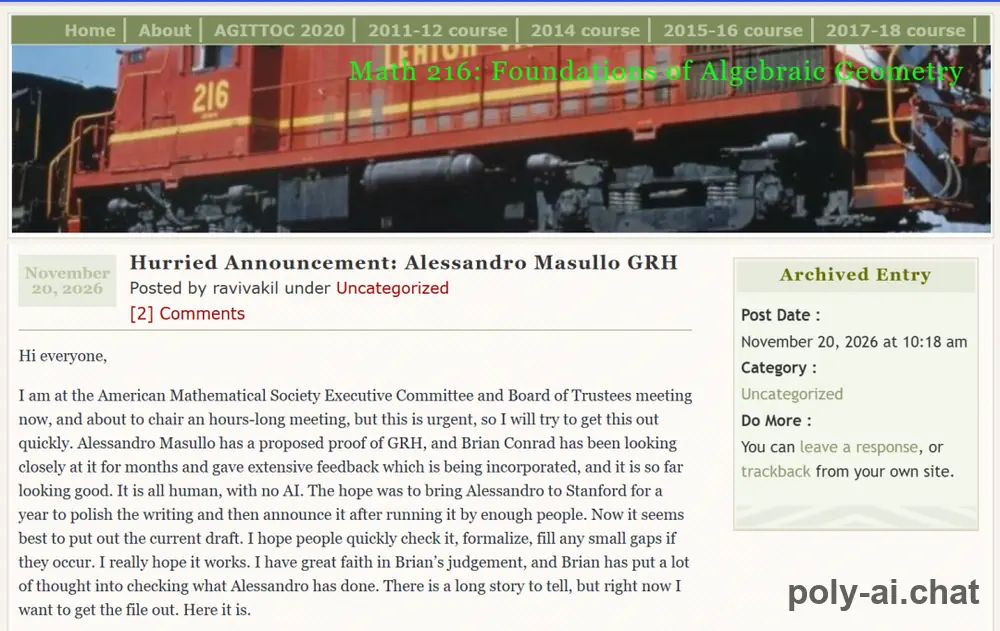
The manuscript, roughly 940 pages long and titled The Music of the Primes, was written by Masullo, who is said to have buried himself in the problem for nearly 12 years.
Vakil went out of his way to stress that the proof was "all human, with no AI."
He also revealed that Brian Conrad, the well-known Stanford number theorist and Masullo's former doctoral advisor, had been quietly reviewing the manuscript for months and had given extensive feedback, and that so far it was looking good.
Why was it "forced" into the open on the same day?
Originally, Stanford planned to invite Masullo back for a visit and spend a year carefully polishing the details, circulating it among more colleagues internally before formally publishing.
But once Anthropic suddenly dropped the bombshell that Claude had proved the Riemann hypothesis, they no longer had a choice.
Brian Conrad and Vakil faced two options: put out the unfinished draft now, or stay silent and publish later.
Given that hard choice, they could only release the draft early and call on the global mathematics community to check it together and fill in the gaps.
Conrad confirmed it: the draft is still at the "major revision" stage, contains unfinished chapters, and has a long way to go before it can be confirmed.
12 Years of Work, and the Plan Was Suddenly Broken by AI
Behind those 940 pages is a 12-year ascetic life in mathematics.
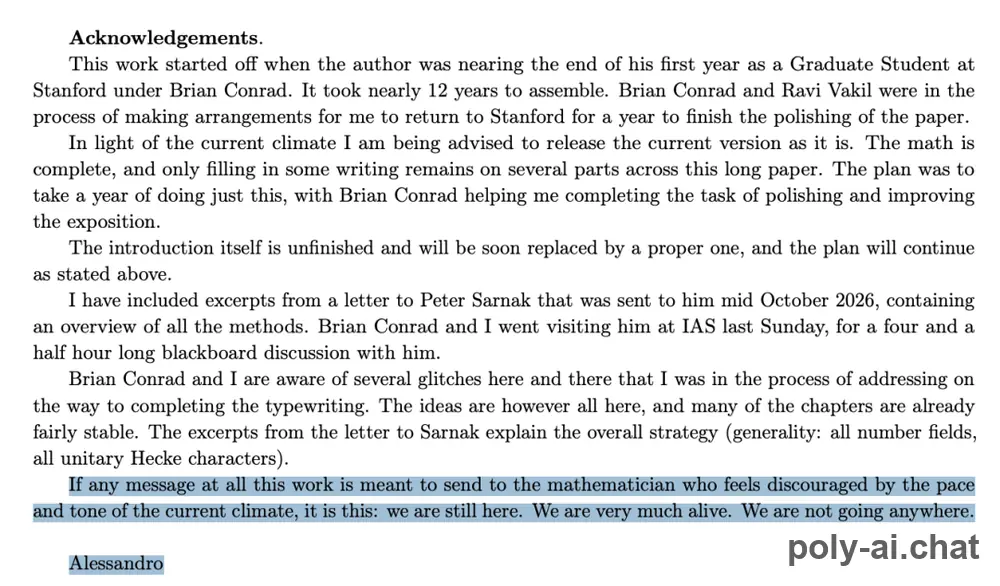
In the opening, Masullo recalls with feeling how the manuscript came to be. It was absolutely not written to ride today's AI hype: he began the proof as his first year of graduate school at Stanford was drawing to a close.
For a full 12 years, Masullo kept refining this enormous system, while Conrad read it word by word and gave extensive comments.
Stanford had been in no hurry to publish. But Anthropic's move left them able to release it only ahead of schedule.
At the end of the acknowledgements, Masullo wrote something close to a last stand:
If this work is meant to send any message at all to the mathematician who feels discouraged by the pace and tone of the current climate, it is this: we are still here. We are very much alive. We are not going anywhere.
How, Exactly, Did a Human Prove the Riemann Hypothesis?
So in these 940 pages of The Music of the Primes, how does Masullo actually prove it?
The generalized Riemann hypothesis is the extension of the classical Riemann hypothesis. It asserts that all nontrivial zeros of Dirichlet L-functions — and of the more general Hecke L-functions — lie strictly on the critical line Re(s) = 1/2 in the complex plane.
If GRH holds, the classical Riemann hypothesis follows automatically as its simplest special case.
To attack GRH at the highest level of generality — an arbitrary number field F and all unitary Hecke characters — Masullo built a theoretical edifice spanning algebraic number theory, analytic number theory, functional analysis and higher category theory.
The proof runs across 14 chapters and 932 pages in total.
Chapters 1 through 6, plus chapter 9, are the foundational framework. Starting from the adelic and idelic language of Tate's thesis, the author systematically introduces global and S-local adelic theta functions, idelic zeta functions, and Schwartz–Bruhat function spaces with exponential decay.
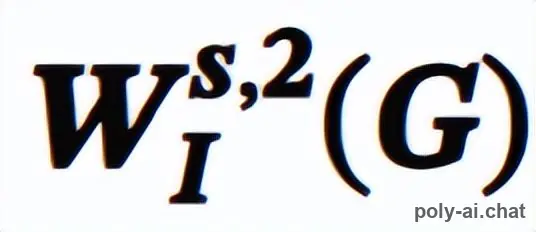
The most crucial piece is chapter 9, where he lays out, for the first time in a systematic way, Hardy–Sobolev spaces with a base interval — the core bridge connecting complex analysis to operator theory on Hilbert spaces.
The most original breakthrough of the work is the construction of a modulation group, periodic Schauder bases and Markushevich bases on the idelic zeta function space, and from these a "shell structure" framework.
With those tools, the author builds an entirely new trace formula on the new Hilbert space and rigorously computes both its spectral side and its geometric side.
Finally, through holomorphic families of test functions and explicit formulas, he pins down the location of the zeros of Hecke L-functions, and discusses zero multiplicities, global function fields of positive characteristic, and higher-rank cases.
The core proof: inheriting from Alain Connes' program, and breaking past it
In the introduction, Masullo writes out his roadmap clearly and compares it with the classical spectral-interpretation program of Fields medalist Alain Connes and of Christopher Deninger.
In the late 1990s Connes proposed explaining the zeros through noncommutative geometry and the operator spectrum on the adelic class space. But his entire work stayed inside the standard L² setting, which ran into insurmountable obstacles when handling convergence and divergent terms.
Masullo takes a completely different route, and it is a delicate one!
Step one: construct the "fundamental divisor exact sequence." Rather than jumping straight into L², Masullo first works at the level of Hausdorff locally convex topological vector spaces, examining the short exact sequence formed by the global theta-function space, the exponentially decaying Schwartz–Bruhat space, and the quotient space. Through the Mellin transform, this sequence corresponds precisely, on the complex plane, to a divisor exact sequence on the sheaf of analytic functions — one that directly encodes the zeros of the Hecke L-functions and their multiplicities.
Step two: bring in the Hardy–Sobolev completion and the "spectral kernel." Masullo then applies a new Hardy–Sobolev completion to that exact sequence, turning it into an exact sequence of three Hilbert spaces. From this he proves that the operator induced on the quotient space is trace class, and that its trace equals exactly the sum of the contributions of all L-function zeros ρ inside the critical strip. That is the spectral side of the trace formula; the corresponding integral kernel is called the spectral kernel.
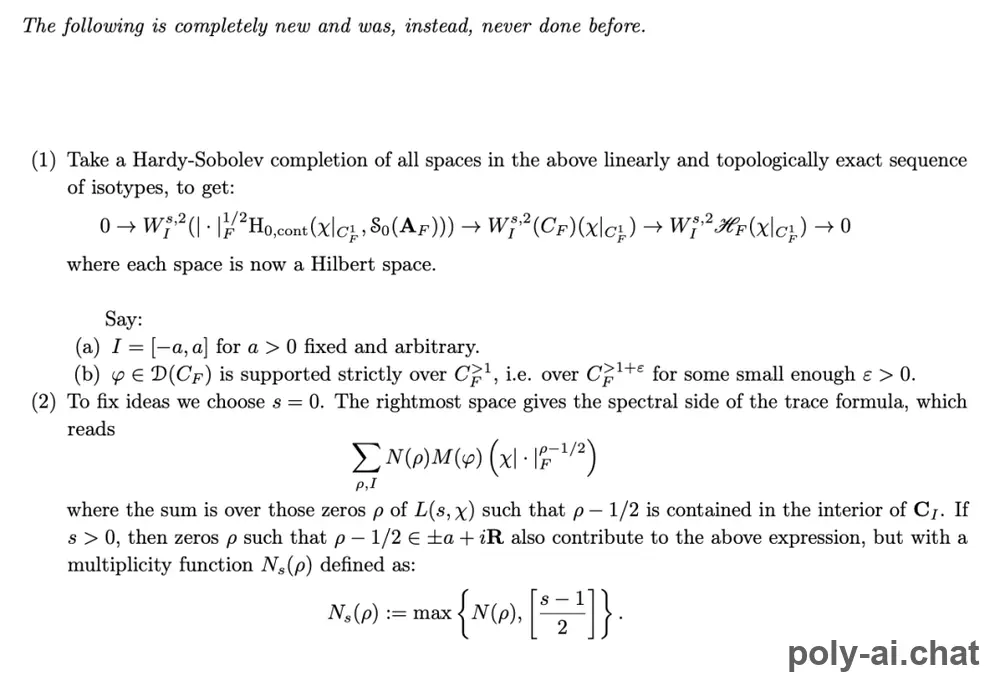
Step three: orbital decomposition of the geometric kernel, and prime-by-prime cancellation. Because of the support properties of the test function φ, the convolution kernel vanishes identically on the diagonal (x, x). The difference is defined as the geometric kernel. After smoothing along the diagonal via the Lebesgue differentiation theorem, the diagonal integral of the geometric kernel equals exactly the negative of the spectral-side sum over zeros.
And here comes the most exquisite part of all 940 pages!
Using his own orbital Schauder bases, Masullo splits the geometric kernel into an infinite series, each term corresponding to a set of prime places of the number field F. By constructing bases on subspaces of the theta-function space, he expresses every orbital kernel as a limit of finite-rank operators.
In the end he computes that for every prime outside the bad set of places, the diagonal integral of its orbital kernel is identically zero.
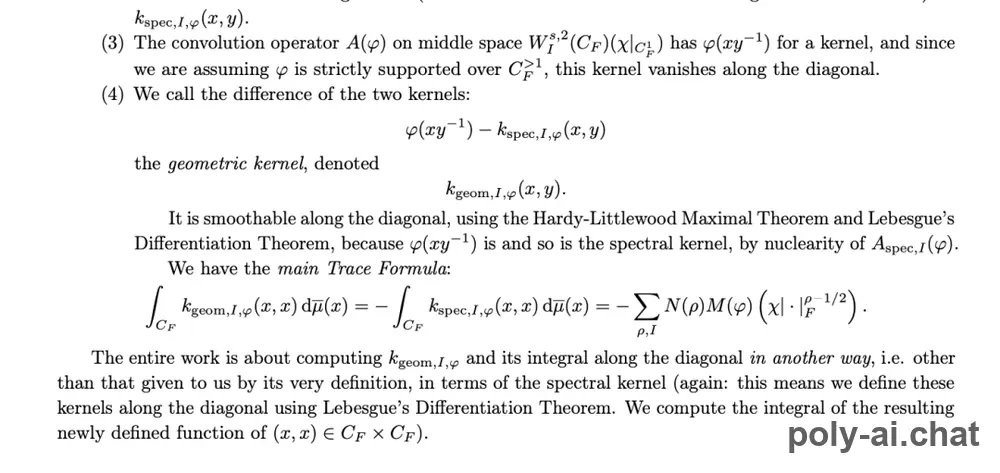
That converts a complicated global problem about zeros into an exact matching of local and geometric terms — and with that, the proof of the generalized Riemann hypothesis is complete.
Terence Tao Posts: Claude Did More Than Prove the Riemann Hypothesis
So what is the mathematics community's attitude toward the two proofs?