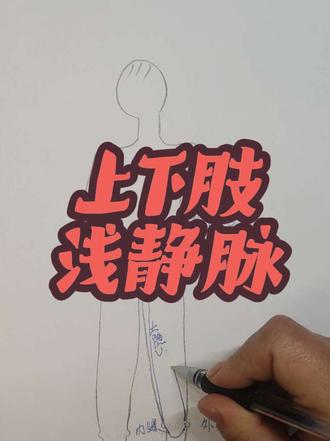
Under an anatomy teaching video about the superficial veins of the upper and lower limbs, the most resonant comment reads: "If it had been explained this clearly back then, I'd have aced anatomy." Why is medical school content showing up on ordinary people's feeds? Because the barrier to human anatomy was never the knowledge itself — it was the way it was taught.
Why People Binge an Anatomy Video at Midnight
The video "Human Anatomy: Superficial Veins of the Upper and Lower Limbs" walks through the vein routes one by one — where the cephalic and basilic veins run, and where they sit shallowly enough to see. A commenter from Hubei captured the mood: "If it had been explained this clearly back then, I'd have aced anatomy." One from Hebei immediately requested the next episode: "Great teaching — can you do the nervous system?" And a viewer from Guangxi wrote: "Came here at midnight and finally it all makes sense."
The textbook presents venous pathways as a static diagram; the video turns them into routes you can visually trace.
Medical Knowledge Is Genuinely Going Public
This isn't an isolated case. Per Outlook (Liaowang) news weekly (November 10, 2026), China's Ministry of Education launched the nationwide "Learning by Doing" (Zuo Zhong Xue) pilot for compulsory education this fall, and Shanghai alone has built more than 9,300 project-based learning cases covering about 1,400 schools across 16 districts.
For adults, short video is backfilling the lessons they never got; for children, it's the extracurricular extension of science education's shift "from books to doing." **Understanding why nurses draw blood from the inner elbow beats memorizing the term "superficial vein."**
The Boundaries of Learning Anatomy From Video
Three limits to keep in mind:
- **Understanding structure ≠ making diagnoses**: knowing vein routes doesn't qualify you to judge "is something wrong with my vessels" — leave that to doctors;
