Mow a lawn and the smell arrives before you finish the first strip. Most people file it under summer, freshly cut grass, the smell of a Saturday. The plant files it under damage. Those molecules are being released by cells that have just been sliced open, and the mixture was assembled in the seconds after the blade passed through.
What actually reaches your nose
The dominant compound is cis-3-hexenal, a six-carbon aldehyde with a sharp green note. Alongside it are hexanal, cis-3-hexenol, and a handful of esters, all of them small, volatile, and produced only when tissue is broken. Cis-3-hexenal is detectable at extraordinarily low concentration, around a quarter of a part per billion, which is why a single mown lawn can scent a whole street.
It is also unstable. Within minutes cis-3-hexenal rearranges into trans-2-hexenal and reduces to cis-3-hexenol, and the smell shifts from raw green to something softer and slightly fruity. If you have noticed that cut grass smells different an hour later, that is not your nose adapting. The chemistry in the air has changed.
The reaction takes seconds and needs a broken cell
The precursors are ordinary membrane lipids, linolenic and linoleic acid, stored in chloroplast membranes. Grinding or cutting ruptures cells and mixes enzymes that are normally kept apart.
A lipoxygenase adds oxygen at carbon 13 of the fatty acid chain, producing a hydroperoxide. A second enzyme, hydroperoxide lyase, cuts that molecule in two: one half becomes the six-carbon aldehyde you smell, the other becomes a twelve-carbon fragment that plants use as a wound hormone. Alcohol dehydrogenase can then reduce the aldehyde to an alcohol, and an alcohol acyltransferase can attach an acetate to make an ester.
There is a neat detail in that last step. The aldehydes can be made by dying cells, because the first two enzymes are present and active in damaged tissue. The alcohols and esters require intact cells with reducing power, so the later, softer part of the bouquet comes only from tissue that survived the cut. The smell of a lawn is therefore a mixture of what died and what is still alive and responding.
Why a plant spends energy on a smell
Three functions are reasonably well supported. The volatiles are antimicrobial and can inhibit fungi and bacteria at the wound. They can deter some herbivores directly. And they attract the natural enemies of the insects that are eating the plant, which is why parasitoid wasps orient toward damaged leaves.
A fourth function, warning neighbouring plants, is the one that gets repeated most confidently and deserves the most caution. Plants exposed to green leaf volatiles do show primed defences: faster calcium signalling, membrane depolarisation, and stronger responses to later attack. Whether that matters in a field, at realistic concentrations and distances, is still argued. Lab experiments often use pure compounds at doses that may not occur in nature.
18px;orphans:2;text-align:start;text-decoration-color:initial;text-decoration-style:initial;text-decoration-thickness:initial;text-indent:0px;text-transform:none;white-space:normal;widows:2;word-spacing:0px;" data-page-node-id="vB7pRTNKfoSmEHnqj5s3HI" data-dm-ref="20">The honest summary is that the molecules are signals, that the plant is not broadcasting for human benefit, and that the ecological conversation is real but less tidy than the popular version.
The part you cannot hear
In 2023 a team at Tel Aviv University put tomato and tobacco plants in acoustic chambers and recorded them with ultrasonic microphones. Undamaged plants were nearly silent, less than one sound per hour on average. Plants that had been drought-stressed or had their stems cut emitted dozens of clicks per hour, in the range of roughly 40 to 80 kilohertz, well above the roughly 16 kilohertz ceiling of adult human hearing.
The likely source is cavitation in the xylem, where water is under tension and a bubble forming and collapsing produces a small shock. A machine-learning classifier could tell drought from cutting with about seventy percent accuracy, and the signals were still detectable in a noisy greenhouse. The authors were careful about what this means. It is evidence that the sounds exist and carry information. It is not evidence that other plants are listening.
That distinction is the useful part of the paper. It turned "do plants make noise" from a rhetorical question into a measurement, and left the harder question open rather than answering it in the abstract.
A suburban lawn is also a chemical source
There is a less charming consequence of the same chemistry. The six-carbon aldehydes and alcohols released by cut grass are reactive hydrocarbons, and in sunlight they react with nitrogen oxides to form ozone and secondary organic aerosol. Estimates of how much of an urban area's reactive hydrocarbon load comes from lawn mowing vary, but the contribution is not trivial in cities with large mown surfaces.
So the smell is a small air-quality event as well as a plant wound response, and the two are the same molecules. A compound that a parasitoid wasp reads as a location, and that a human reads as summer, is also a precursor in photochemical smog. The plant did not evolve it for either of the last two purposes.
What the cut edge looks like
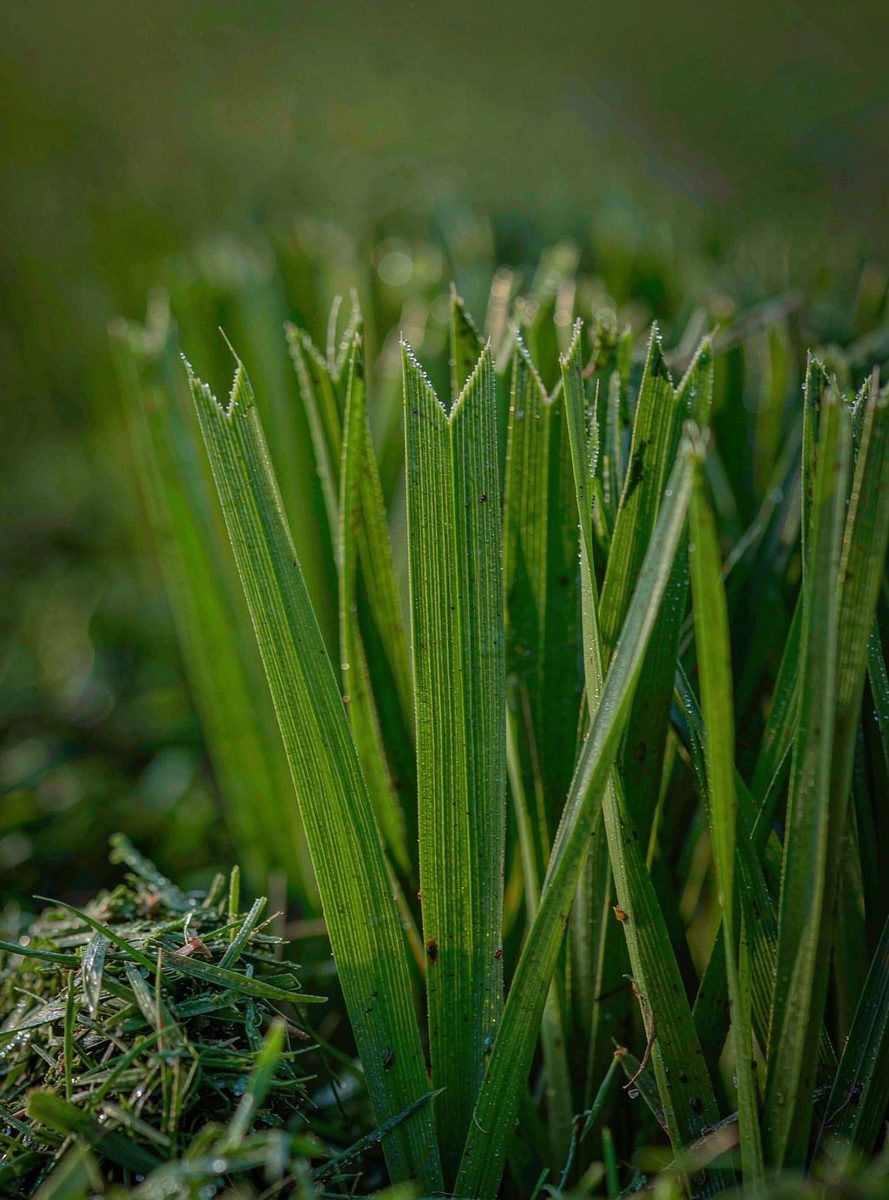
Under a hand lens, a cut grass blade shows crushed cells along the wound and intact tissue a few cell layers back. Under a compound microscope, the difference is sharper: ruptured epidermal cells, chloroplasts spilled into the wound, and nearby cells with intact membranes and visible nuclei.
That distribution is the whole explanation for the two-stage smell. Enzyme and substrate meet only where membranes have failed, and the products that need a living cell appear only where they have not. A section through a leaf blade, with its parallel veins, bundle sheath and stomata, is enough to make the point that a plant is not a bag of chemicals but a set of compartments, and that damage is largely a story about compartments opening.

If you want to look at a leaf section rather than a photograph of one, Wwai pairs a scanned slide library with an AI lab partner, so the tissue layers behind the smell can be examined at high magnification.