The frog is under two inches of leaf litter, on a north-facing slope, in a temperature that has been below zero for eleven days. Its heart is not beating. Its lungs are not moving. Roughly two thirds of the water in its body is ice, and if you picked it up it would clink like a stone against a bucket. In April it will walk away.
Wood frogs do this every winter across a range that runs from the Arctic treeline to the southern Appalachians. What makes the animal worth a lesson is not the drama of the freeze but the specificity of the survival: ice is allowed to form almost everywhere except inside the cells, and the frog spends the autumn preparing exactly that outcome.
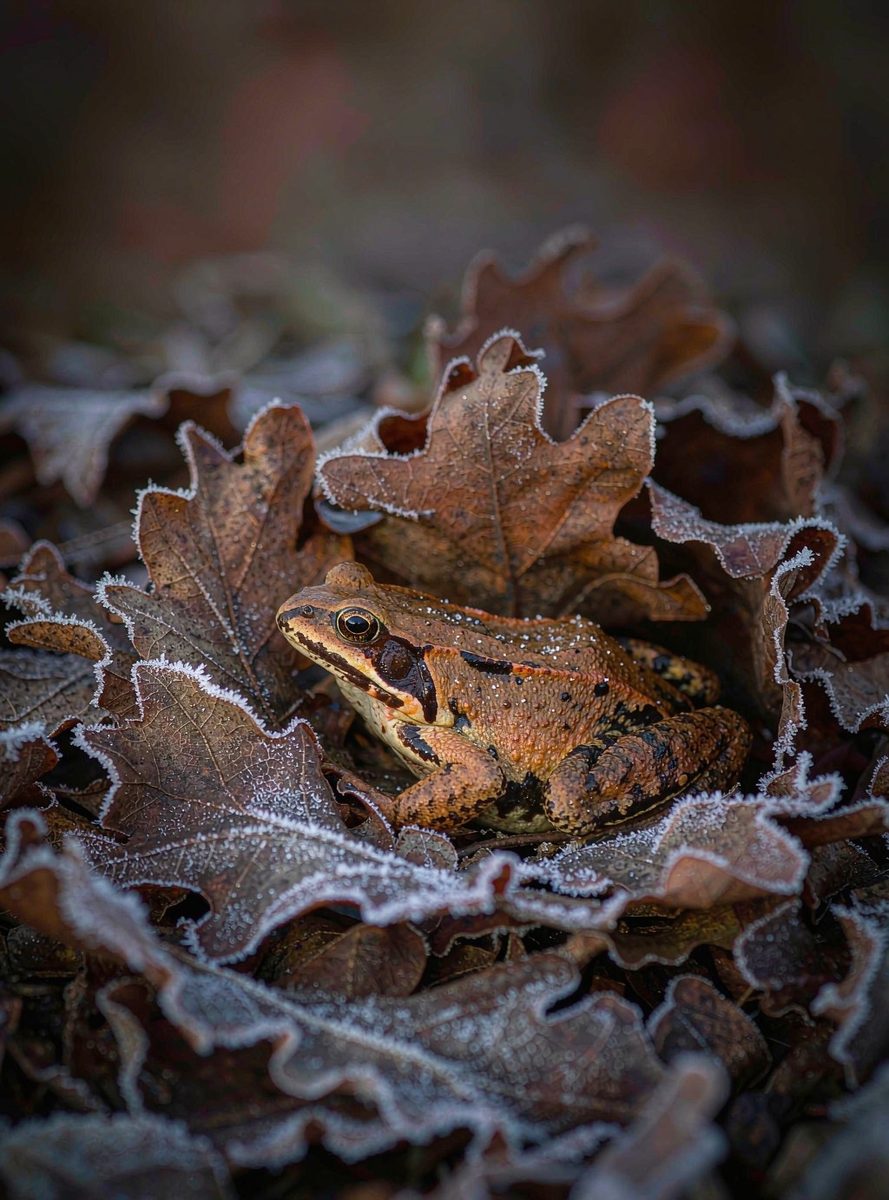
The ice is outside the cells, and that is the whole trick
Freezing kills tissue for a simple physical reason. Water expands as it crystallises, and a crystal growing inside a cell shreds membranes and organelles that cannot be rebuilt. A wood frog avoids this by letting ice form where it does no immediate harm, in the blood, the lymph, the gut, and the spaces between cells.
As extracellular ice grows, it pulls water out of the cells by osmosis, because the remaining unfrozen fluid outside is now more concentrated than the cytoplasm. The cells shrink, sometimes by a third of their volume, and the little water left inside them is loaded with solutes. That concentrated interior supercools instead of freezing, even as the body temperature drops well below zero.
So the sequence is counterintuitive. The animal freezes, and the cells dehydrate. The dehydration is not a side effect to be survived; it is the mechanism. Anyone who has watched a slug shrivel in salt has seen the same osmotic rule, applied here on purpose.
Where the antifreeze comes from
The solute that does most of this work is glucose, and the frog manufactures it on demand. Through the autumn it packs glycogen into its liver, at several times the concentration found in frogs that overwinter underwater. When ice first touches the skin, the liver breaks that glycogen down and releases glucose into the blood, and the heart rate rises sharply within the first minute to circulate it.
Concentrations in the core organs reach the low hundreds of millimolar, a level that would mark a human as severely diabetic. Cells also increase the number of glucose transporters on their membranes in autumn, so the sugar is taken up quickly rather than sitting in the plasma. Urea accumulates alongside it, roughly tenfold over the season, and adds to the osmotic effect without the same metabolic cost.
There is a second line of defence against the ice that does form. A protein called Fr10 appears in the blood and tissues during freezing and binds to ice crystal surfaces, limiting recrystallisation, the process by which small crystals merge into larger, more damaging ones. In freeze-tolerant animals this kind of ice-binding activity matters more than the dramatic antifreeze effect that keeps freeze-avoiding insects liquid. The frog is not trying to prevent ice. It is trying to keep the ice small and well behaved.
