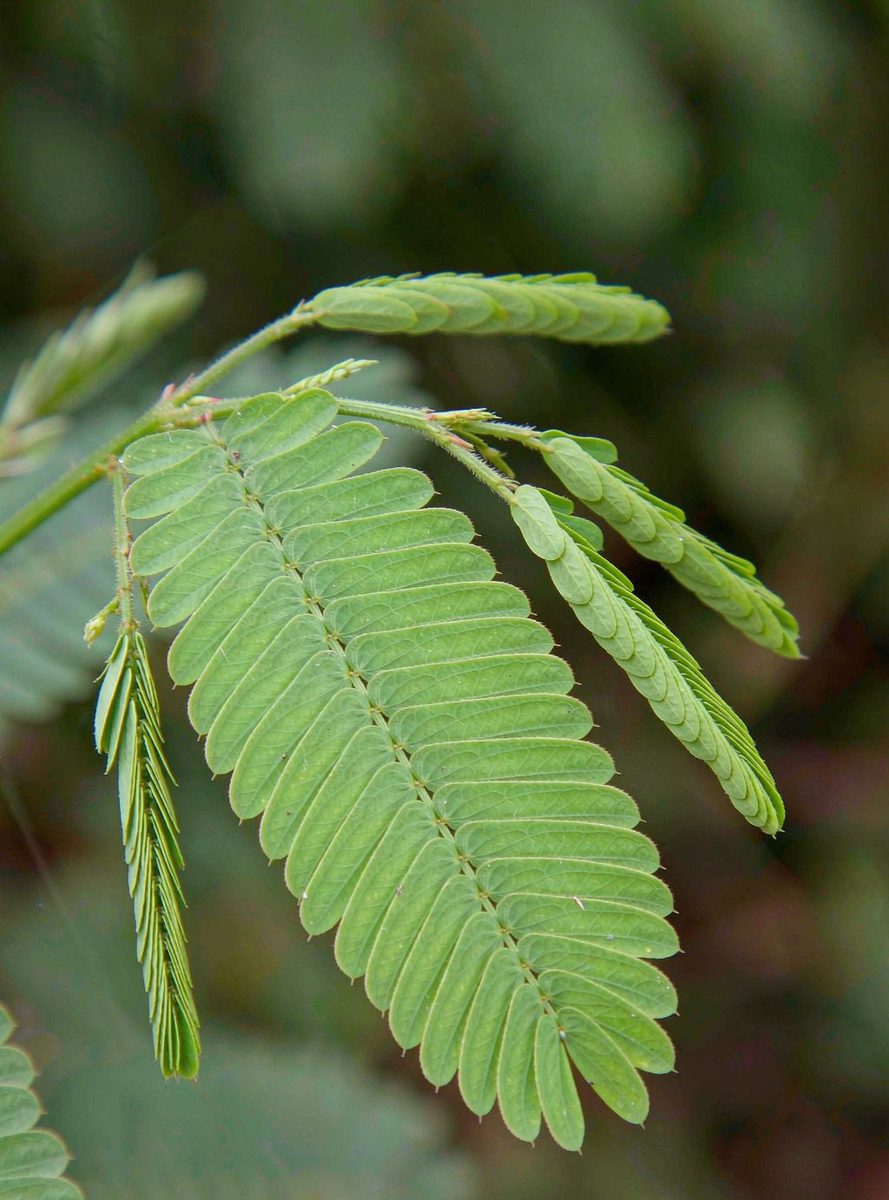
A mimosa in a pot by a window is the cheapest demonstration of plant physiology available. Brush one leaflet with a fingertip and the pairs fold together within a second or two. Press harder and the whole leaf droops from its stalk, as if the plant had lost interest in standing up. Wait ten or twenty minutes and it comes back.
There is no muscle in any of that. What moves is water, shifting between compartments inside a specialised organ, and the plant spends almost no energy on the actual movement. It is one of the few pieces of plant biology a student can trigger, time and photograph on a windowsill.
The joint that does the work
At the base of each leaflet, at the junction between the leaf stalk and each pinna, and at the base of the whole leaf where it meets the stem, there is a swollen structure called a pulvinus. The arrangement is nested: three levels of joint, which is why a light touch folds a few leaflets and a hard one takes down the entire leaf.
Inside a pulvinus, the tissue is parenchyma with large intercellular spaces, and each cell holds a big central vacuole. In the resting state the cells are fully turgid. Water pressing outward on the cell walls keeps the tissue firm, and the pulvinus acts as a rigid hinge holding the leaf out flat.
When the leaf is disturbed, ion channels in the pulvinus cells open, ions leave the cells, and water follows by osmosis. The cells of the lower side lose turgor and collapse; the cells on the upper side keep theirs. The hinge buckles, and the leaflet folds. Recovery is the same process in reverse, as ions and water are pumped back and the cells re-inflate.
The signal travels like a nerve impulse, but is not one
The collapse is far too fast to be explained by diffusion of a chemical messenger. What propagates through the plant is an electrical signal, a transient depolarisation of the cell membrane that moves from cell to cell and can travel along the vascular tissue. It behaves like an action potential in an animal nerve in the sense that it is all-or-nothing and self-propagating, and it is the reason the response can cross a leaf in a second.
The resemblance stops there. There are no neurons, no synapses and no brain. The signal is a wave of ion movement through ordinary plant cells, and the "decision" to fire is a threshold property of the membrane rather than a computation. When a popular article calls mimosa a plant with nerves, that is the overreach to watch for. It has excitable cells. It does not have a nervous system.
Mimosa also has a slower daily rhythm, folding its leaves at night and opening them in the morning, which is a separate clock-driven process and does not require a touch. Sorting the fast touch response from the slow circadian one is a good exercise in reading a plant carefully.
Why collapse at all
The standard explanation is defence. Mimosa is native to tropical South America, where a leaf can be shredded by wind-driven rain or chewed by an insect in the time it takes to grow a replacement. Folding removes the exposed lamina and drops the silhouette; the sudden movement also startles a herbivore that was expecting a stationary meal.
The cost is real. A folded leaf is not photosynthesising, and repeated triggering in a greenhouse produces a plant that stays folded longer and grows more slowly. There is a trade-off between being eaten and being fed, and the plant resolves it by responding only to stimuli above a threshold.
Some of the more dramatic claims around mimosa deserve caution. The idea that it can predict earthquakes circulates widely online and has no credible experimental support. The claim that mimosa "learns" not to close after repeated harmless drops comes from a single 2014 study that has been criticised for its design and has not been robustly replicated. I mention both because students will find them, and because the difference between a measured response and an over-interpreted one is part of the subject.
What the slide shows
A transverse section through a pulvinus is unusually satisfying under a microscope, because the mechanism is visible as geometry. The organ is a bulge of thin-walled parenchyma cells with conspicuously large vacuoles, arranged around a central vascular bundle. On the two sides of the hinge, the cells differ in size and in the thickness of their walls, and that asymmetry is the whole trick: one side can collapse while the other holds.
Because the cells are large, a hand section stained with iodine or neutral red will show the vacuoles clearly, and students can measure cell size on both sides of the hinge and see the difference for themselves. It is a rare case where a measurement taken from a slide explains a behaviour observed on a plant.
The other useful preparation is the leaflet epidermis, which carries touch-sensitive hairs and, in mimosa, a surface that responds to mechanical distortion. Comparing the upper and lower epidermis, and locating the stomata, gives a second view of the same organ system at a different scale.
Why it earns a place in a syllabus
Most plant movement taught in school is tropism: roots down, shoots up, slow and directional. Mimosa is the exception that shows plants can also act on a timescale students associate with animals, and it does so with the same toolkit as everything else in the plant, namely water, ions and cell walls.
That contrast is the teaching point. Once a student has seen a pulvinus collapse, the phrase "plants do not move" stops being usable, and the question becomes how and how fast. The answer, in this case, is a hydraulic hinge driven by an electrical signal, with no nerve anywhere in the circuit.
If you want to put the hinge itself under the lens, Wwai pairs scanned plant sections with an AI lab partner, so the pulvinus, the epidermis and the vascular tissue can be compared at the same sitting.
