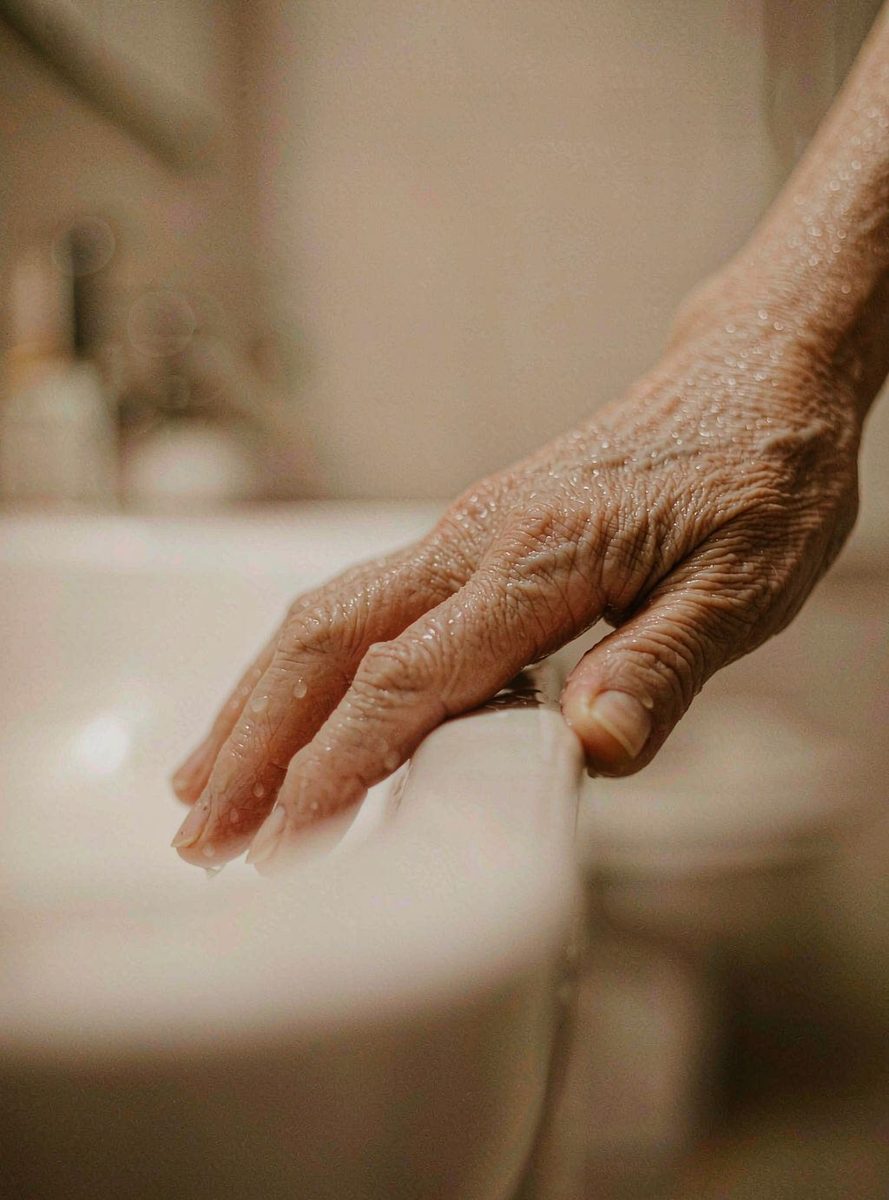
After twenty minutes in a bath, my fingertips look like the surface of a walnut. The obvious explanation is that the skin has absorbed water and swollen, the way a dried bean swells in a bowl. It is a satisfying explanation, it is repeated in a great many places, and it is wrong.
The first clue is anatomical. If soaking made skin swell, the whole body would crinkle. Arms, legs, back and face spend just as long in the water and keep their usual texture. Only the palms and the soles wrinkle, and they do it in a pattern of long ridges that looks less like swelling than like something collapsing inward.
A 1930s observation that should have settled it
The decisive evidence is old. Clinicians noticed that patients with an injured median nerve did not develop the wrinkled fingertip after soaking. Cut the nerve and the wrinkle disappears; restore it and the response returns. If the effect were passive water uptake in the outer skin, the state of a nerve deep in the arm would be irrelevant.
That observation turned the phenomenon into a test. Soaking a hand in warm water became a bedside check for sympathetic nerve function, and it is still used that way in clinics with limited equipment. The skin, in other words, is reporting on the state of the autonomic nervous system. A finger that will not wrinkle is a finger whose nerve supply is not working.
What actually happens
The mechanism, as it is currently understood, runs through blood vessels. Water entering through the sweat ducts changes the local ionic environment of the skin, and the sensory endings there register the change. That triggers sympathetic outflow along the median nerve, which releases noradrenaline onto alpha-adrenergic receptors on the smooth muscle of small arteries and arteriovenous anastomoses in the fingertip.
Those vessels constrict. The fingertip is unusually well supplied with them; the pad contains dense networks and specialised glomus bodies, structures built for temperature control, with a large volume of blood moving through a small space. When the vessels narrow, the tissue loses part of its internal filling and the pad shrinks slightly. The skin above has nowhere to go, so it buckles into the ridges we see.
Two details support this account. First, the wrinkle usually takes about five minutes or more of immersion to appear, which fits a physiological cascade rather than a fast physical process. Second, applying a vasoconstrictor cream to a dry fingertip produces wrinkles of the same kind and depth as water does, without any soaking at all. The water is the trigger, not the cause.
Why only the hands and feet
Palms and soles carry glabrous skin, hairless and thick, with an exceptionally dense population of eccrine sweat glands and a very thick stratum corneum. That combination gives both a route for water to enter and a stiff outer layer that will fold rather than stretch. The skin on the back of the hand has different proportions of the same parts and does not respond in the same way.
yle:initial;text-decoration-thickness:initial;text-indent:0px;text-transform:none;white-space:normal;widows:2;word-spacing:0px;" data-page-node-id="43aeQYGi0PPnytahGQJrei" data-dm-ref="20">The nerve supply matters as much as the skin. The digital nerves carry a dense sympathetic component, and the fingertip vasculature is built to be adjusted quickly for heat loss. A patch of skin with less of either does not produce a visible result. This is a useful reminder that a physiological response can be local without being simple.
The grip hypothesis, and its limits
The best-known functional explanation is that wrinkled fingertips improve grip on wet objects. The ridges form a drainage network, channeling water out from under the contact area so that more skin meets the object. In a 2013 study, participants handled wet and dry stone spheres with wrinkled and unwrinkled fingers; the wrinkled fingers were faster with wet objects and no different with dry ones.
That is a clean result, and it is often presented as the evolutionary reason for the trait. I would hold it more loosely. Improved performance on one laboratory task is consistent with an adaptation, but it does not prove one, and the same response appears in macaques, which suggests the mechanism is older than any human-specific explanation. The vasoconstriction itself has an obvious thermal role, since constricting flow in a cool, wet hand conserves heat. Wrinkling may be a side effect that turned out to be useful, or a selected trait in its own right. The evidence does not yet choose between those.
What the microscope shows
A vertical section of fingertip skin explains the shape of the response. The stratum corneum is thick, layered and heavily keratinised, and beneath it the epidermis is folded into deep rete ridges that interlock with the dermal papillae. Sweat ducts run through the whole thickness in a fairly straight line and open at the surface. Those ducts are the route by which water reaches the living layers.
The ridges on the surface are not random. They are the dermatoglyphic pattern, fixed before birth and shaped by the mechanical stress of the growing skin, which is why fingerprints are stable for life and unique in their fine detail. In section, the ridges appear as a regular corrugated surface, and the sweat duct openings sit along them at intervals.
There is also a vascular point that a slide can make. The dermal papillae are packed with capillary loops, and the density of those loops in a fingertip is high compared with most other skin. The tissue that shrinks when the vessels constrict is a dense capillary bed sitting immediately under a stiff, folded sheet. Structure and mechanism line up.
Why it is worth teaching
Finger wrinkling is a small phenomenon that covers a lot of syllabus. It is a case of autonomic control that students can observe on themselves, a demonstration that a familiar explanation can be wrong, and an example of structure predicting function at the level of skin layers.
It also teaches restraint. The mechanism is well supported; the evolutionary story is a hypothesis with one good experiment behind it. Being able to say which is which is the actual skill, and it is easier to practise on a wrinkled fingertip than on most textbook examples.

If you want the section behind the observation, Wwai gives you scanned skin and tissue slides with an AI lab partner, so the layers a fingertip is made of can be examined rather than imagined.