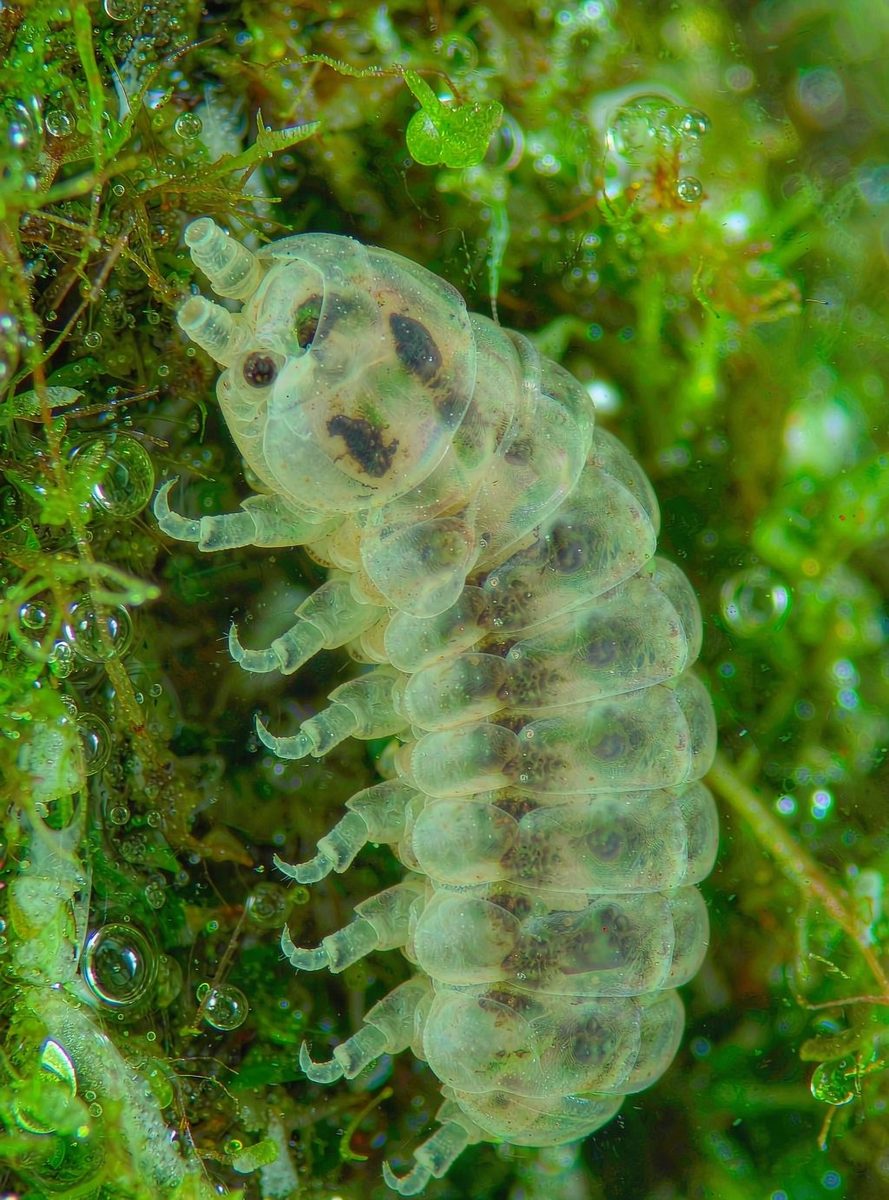
A dry piece of moss from a garden wall, soaked in water for an hour and squeezed onto a slide, will often produce tardigrades. They come out as translucent, barrel-shaped animals with eight stubby legs, each ending in claws, walking across the field of view with a slow, deliberate gait. At around half a millimetre, they are near the useful limit of a school microscope, which is part of their appeal: the animal is small enough to be remarkable and large enough to be watched.
They are also, by most measures, the most durable animals known. A tardigrade can be dried to the point where almost no water remains, kept that way for years, and then revived by a drop of water. Insects do not do this. Neither do vertebrates. The trick is not a tougher cell; it is a controlled shutdown.
The animal
Tardigrades are a phylum of their own, with well over a thousand described species, found from Antarctic moss to deep-sea sediment. The body is segmented and covered by a cuticle that is moulted as the animal grows. They feed on plant cells, algae and small invertebrates, piercing cells with a muscular pharynx and sucking out the contents.
The version most people meet is the "water bear", a name earned by the lumbar gait, and "moss piglet", earned by the shape. Both names are more accurate than they sound: tardigrades need a film of water to be active, and moss is where that film persists longest between rains.
Drying out without dying
The state that made tardigrades famous is cryptobiosis, and the specific form is anhydrobiosis, life without water. As the surroundings dry, the animal contracts into a compact, wrinkled ball called a tun. Water content drops from roughly its normal level to a small fraction of it, metabolism falls to a level that is hard to distinguish from zero, and the animal stops.
In the tun state, tardigrades tolerate conditions that kill almost everything else. Published figures put the range at roughly minus 272 degrees Celsius to about 150 above it, and experiments have kept them alive for days in the vacuum and radiation environment of low Earth orbit. They also survive pressures that would crush most cells, and doses of gamma radiation far above what a human can take.
The interesting question is how. A dried cell normally dies because membranes fuse, proteins unfold and DNA breaks. In tardigrades, the cytoplasm appears to be converted into a glass-like state as it dries, with protective molecules taking the place of water and holding macromolecules in position. Some of these are proteins unique to tardigrades, and their disordered, flexible structure seems to be the point: they can pack around whatever shape they need to protect.
A second line of defence is a protein called Dsup, for damage suppressor. It binds to DNA and appears to shield it from radiation-induced breaks. When the gene was expressed in cultured human kidney cells, X-ray damage to their DNA dropped substantially compared with controls. That result is one reason tardigrades attract attention well beyond zoology, since anything that protects DNA during storage or irradiation has obvious applications in medicine and in the preservation of biological material.
