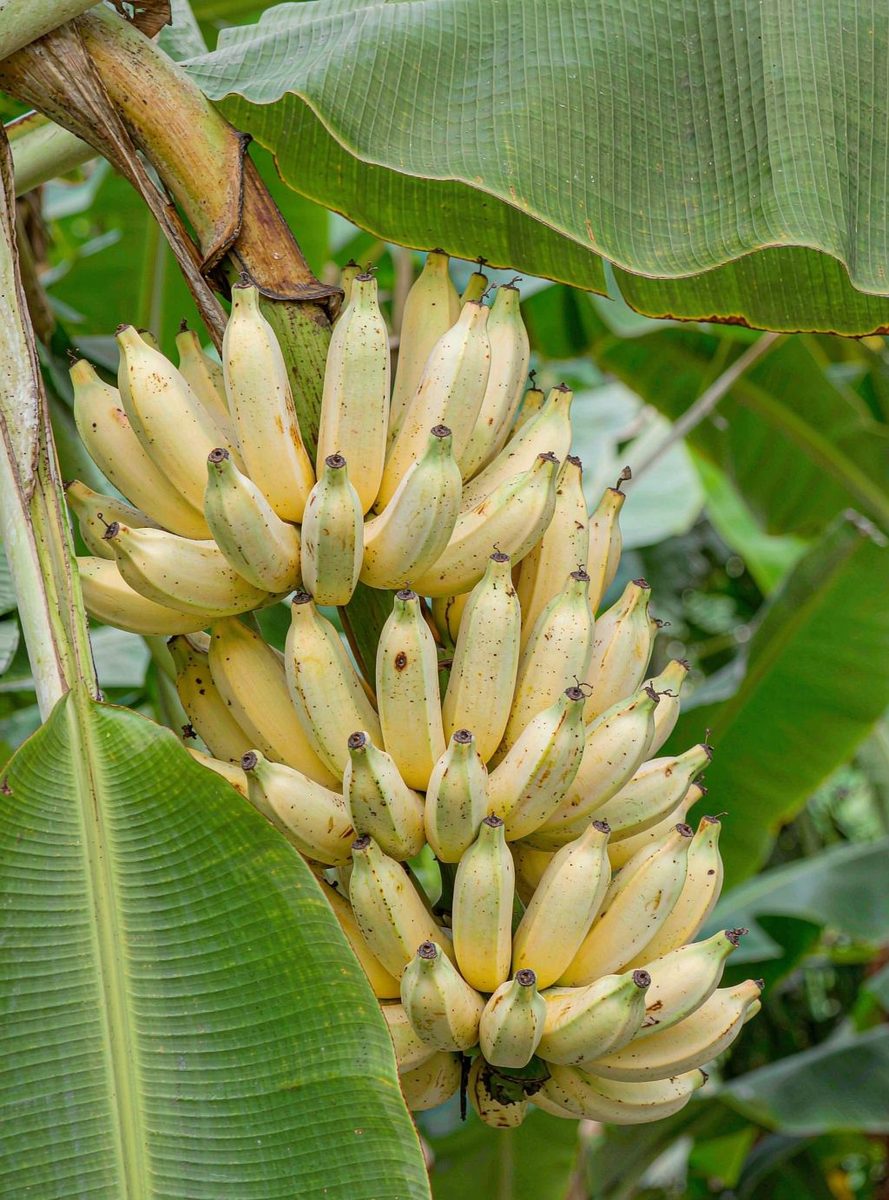
Pick up a banana in a supermarket in Osaka, Manchester or São Paulo and you are almost certainly holding the same cultivar: Cavendish, the long yellow one with the slight green tip. It is not the same species as every other fruit on the shelf — bananas have hundreds of cultivars — but within that yellow supermarket banana, the genetic distance between one fruit and another is close to zero. Cavendish is a single clone, propagated by cutting and tissue culture, and every plant in the global trade is a copy of the same individual. That is efficient, and it is also the reason the industry is worried.
Seedless is a genetic dead end
Wild bananas are full of hard black seeds. The fruit we eat has none, and the reason is a chromosome accident. Cultivated bananas are triploid: they carry three sets of chromosomes instead of the usual two. During meiosis, the specialised cell division that makes gametes, chromosomes have to pair up and separate evenly. With an odd number of sets, pairing fails. The plant cannot produce viable pollen or eggs, so it sets no seed, and it cannot be improved by ordinary cross-breeding.
That leaves vegetative propagation: suckers cut from the base of the parent, or shoot tips multiplied in tissue culture. Every daughter plant is genetically identical to the parent, barring rare somatic mutations. The upside is uniformity — fruit ripens on schedule, size is predictable, supply chains can be planned to the week. The downside is that uniformity applies to defence as well. A pathogen that can infect one Cavendish plant can, in principle, infect all of them.
The first collapse
This has happened before, and the history is well documented. Through the first half of the twentieth century, the dominant export banana was Gros Michel, a thicker, sweeter cultivar that travelled well. Then Panama disease arrived: a wilt caused by the soil fungus Fusarium oxysporum f. sp. cubense. The fungus enters through the roots, colonises the water-conducting vessels of the pseudostem, and blocks them. The plant wilts and dies, and the soil stays infested.
The strain responsible, known as TR1, spread through the plantations of Central and South America and effectively ended Gros Michel as a commercial crop by the 1950s. Growers replaced it with a cultivar that happened to be resistant: Cavendish, named after the greenhouse of the Duke of Devonshire, where it had been grown as an ornamental. The industry did not solve the problem. It switched to a different clone and bought itself about fifty years.
TR4, and a longer shadow
The fungus evolved. A new strain, tropical race 4, appeared in Taiwan in 1989 — some accounts point to Malaysia in the same period — and Cavendish has no resistance to it. TR4 has since been confirmed in more than twenty countries across Asia, the Middle East, Africa and, since 2019, Colombia, which is a major exporter. The pattern is the same as before: vascular wilt, collapse, and a field that cannot be replanted with bananas for decades because the spores survive in soil for thirty years or more. Fungicides do not reach the fungus inside the plant, and there is no cure once a field is infected.
or:initial;text-decoration-style:initial;text-decoration-thickness:initial;text-indent:0px;text-transform:none;white-space:normal;widows:2;word-spacing:0px;" data-page-node-id="XVtVjEbU58kc6g2jBXfQJv" data-dm-ref="18">The difference from the 1950s is that the industry is far more concentrated now. A single cultivar supplies the majority of export trade, and the export trade supplies a large share of the fruit eaten in temperate countries. That is the vulnerability the "banana is going extinct" headlines are pointing at. The headlines overstate it — the banana as a species is in no danger, and there are more than a thousand cultivars, many of them resistant — but the specific banana in the supermarket is genuinely exposed.
Why the section looks the way it does
Banana is a good plant for a microscope because almost everything about its oddness is visible in tissue. A cross-section of the pseudostem shows vascular bundles scattered through the parenchyma rather than arranged in a ring, which is the signature of a monocot. Those bundles are what TR4 plugs. In an infected plant, the xylem vessels darken and fill with gum and fungal hyphae, and a hand section through a wilted stem can show the discoloured vascular tissue directly, without any staining beyond what the plant provides.
Pollen is the other useful specimen. A triploid banana produces pollen mother cells that cannot complete meiosis properly; the chromosomes fail to pair and segregate, and the resulting pollen is mostly sterile and irregular in size. In a stained preparation, the abnormality is visible as unbalanced divisions and variable grain size. It is a concrete way to see why a triploid cannot be bred the usual way, and why every new Cavendish has to come from a cutting.
Stomata, epidermal cells and the waxy cuticle are all easy to prepare from a banana leaf, and the leaf is large enough that a student can take a section without destroying the plant. For a syllabus that wants students to connect genetics to agriculture, banana is unusually direct: the chromosome problem, the propagation method and the disease vulnerability are the same story told at three scales.
What the case teaches
The banana story is the cleanest example I know of a general principle: agricultural uniformity is a bargain, and the price is paid later. Every crop bred for uniformity — wheat, rice, potatoes, bananas — trades genetic diversity for predictability, and the trade works until a pathogen finds the gap. The Irish potato famine is the same lesson with a harsher outcome. Cavendish has simply not yet reached its crisis point in most of the world.
The responses now under development are worth knowing about, because they show the options. Conventional breeding works where fertile diploid relatives can be crossed in. Genetic modification and gene editing can introduce resistance genes directly, though regulation and public acceptance vary. Somaclonal variation — the small mutations that accumulate in tissue culture — occasionally throws up useful tolerance. And crop diversification, planting several cultivars instead of one, is the oldest answer and the least glamorous.
None of this makes the supermarket banana disappear tomorrow. It does mean that the fruit is a case study in why genetic diversity matters, which is a syllabus point that is much easier to teach with an object students have held in their hands.
If you want to see the tissue behind the headlines, Wwai gives you scanned sections of plant stems, leaves and pollen alongside an AI lab partner, so the genetics and the anatomy can be studied side by side.