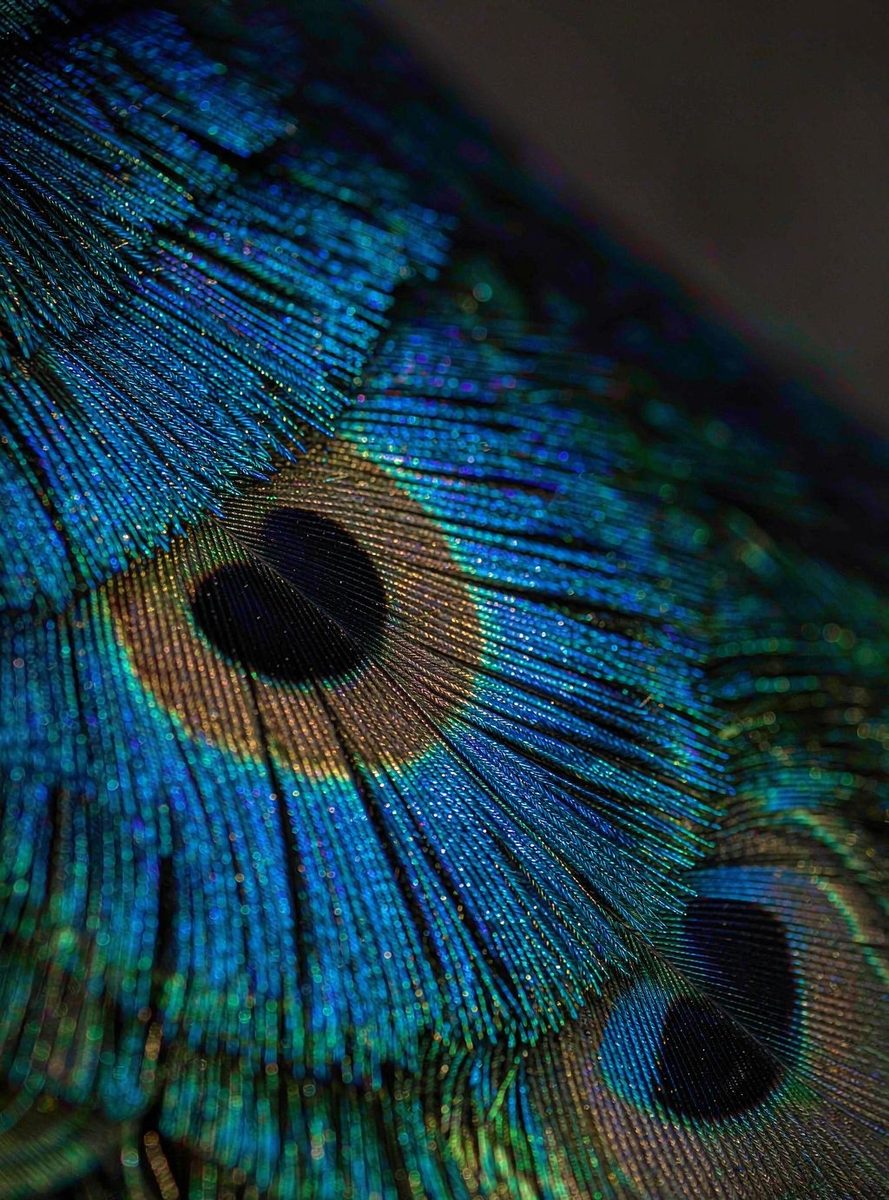
Hold a peacock feather at arm's length and the eye spot looks like a jewel: a deep teal core, a bronze ring, a rim of green that shifts as you turn your wrist. Now ask the obvious question. What pigment makes that blue? The answer is none. There is no blue pigment in a peacock feather, no blue molecule anywhere in the bird. The blue is a physical structure, built out of the same dark melanin that colors a suntan, arranged into a crystal fine enough to bend light. Once I understood that, the feather stopped looking like decoration and started looking like a manufactured optical device, assembled cell by cell.
The only pigment in the feather is brown
Melanin is not blue. In feathers it reads as black, brown or bronze, depending on how densely it is packed. Peacock barbules are full of it. Under a scanning electron microscope, the outer layer of a barbule — the cortex — turns out to be a lattice: tiny rods of melanin, roughly 0.7 micrometres long, laid parallel to the surface, connected by keratin, with air filling the gaps. The rods sit in a repeating two-dimensional grid, like pencils stacked in a rack.
A grid with a spacing close to the wavelength of visible light does something no pigment can. Light entering the structure bounces off successive layers, and the reflections interfere: some wavelengths come back in phase and reinforce, others cancel. The wavelength that survives the trip is the colour you see. Blue emerges when the rod spacing happens to reinforce short wavelengths. Green emerges when the spacing is slightly wider. Nothing in the feather is coloured; the geometry selects a colour out of white light.
A few nanometres separate a blue feather from a green one
The detail that still impresses me is how little the structure has to change. In a 2003 study in PNAS, Jian Zi and colleagues sectioned the blue, green, yellow and brown barbules of a green peacock's train and compared their lattices. All of them contained the same kind of photonic crystal — melanin rods in keratin, in the same square arrangement, sitting above a spongy medullar core about 3 micrometres across. The differences were almost trivial: the spacing between rods, and the number of rod layers stacked under the surface.
Change the spacing, and the reflected wavelength shifts, so blue becomes green becomes yellow. Reduce the number of repeating layers, and the reflection weakens and mixes with light that passes through, producing the browns and bronzes. Two knobs, essentially, and the bird gets a full palette. Zi's team described the strategy as "ingenious and rather simple," which is the most polite way a physicist can say that evolution found a cheaper solution than the one in the textbook.
Why the colour moves when you tilt it
If the colour came from pigment, the angle of the feather would not matter. Because it comes from interference, it does. Tilt a barbule and the path length through the lattice changes, so a different wavelength satisfies the reinforcement condition. That is the shimmer you see when a peacock fans its train and the eye spots slide from teal to violet and back. It is also why the colour does not fade in sunlight the way a dyed fabric does. Pigments are molecules that get broken by ultraviolet light; a lattice of melanin and keratin has no comparable weak point. Zi made exactly this point when discussing applications: structural colour is durable because it is geometry, and geometry does not bleach.