Every November I drive the same road and watch the maples go from green to yellow to a red so saturated it looks artificial. The yellow part is easy to explain: chlorophyll breaks down and the carotenoids underneath become visible, like a coloured underlayer in a photograph. The red part is stranger. There is no red underlayer. The tree builds it, from scratch, in a leaf it is about to throw away. Spending energy on a structure you are dismantling is the kind of decision that makes no sense until you look at what the leaf is trying to save.
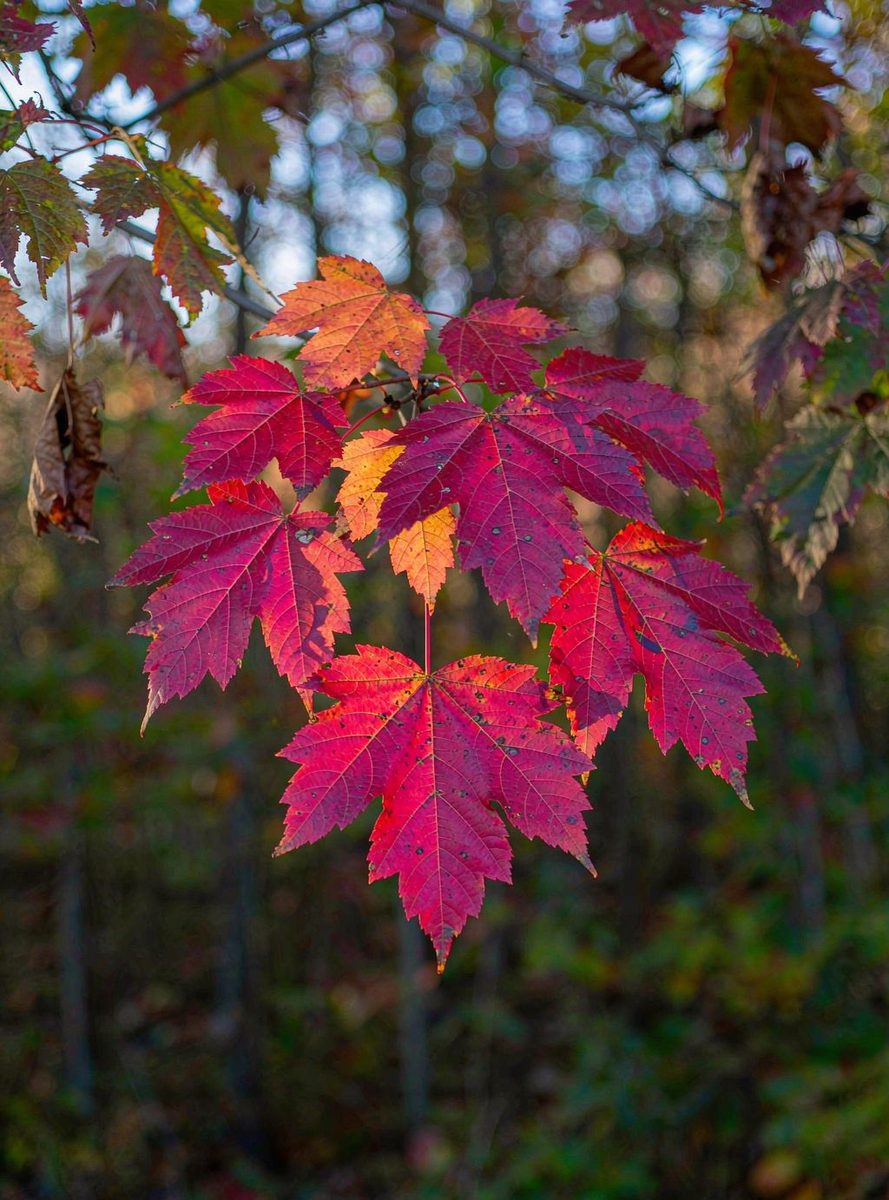
Yellow is revealed. Red is manufactured.
In summer, chlorophyll dominates by sheer quantity. Its absorption spectrum swallows the red and blue ends of visible light, which is why leaves read as green. When autumn arrives, the plant stops maintaining the photosynthetic machinery. Chlorophyll is dismantled, and the carotenoids that were always present — xanthophylls and carotenes — are no longer masked. Yellow is therefore a subtraction: something was removed.
Anthocyanins are the opposite. They are not sitting in the leaf waiting to be revealed. The plant switches on genes for the pathway that builds them, starting with PAL and CHS, and spends soluble sugars and ATP to assemble a pigment that did not exist a week earlier. The finished molecules are then actively pumped into the vacuole, the storage compartment of the cell, where they accumulate into the crimson and purple that makes a sugar maple look lit from inside. The leaf pays for this in carbon at exactly the moment it is trying to recover as much as it can.
That contradiction is why autumn colour has been argued over for more than a century. A dying leaf that invests in new pigment is doing something, and the question is what.
The argument for a light screen
The leading explanation is photoprotection. Autumn days are bright and cold. Cold slows the enzymatic steps of photosynthesis, so the light reactions keep harvesting energy that the dark reactions cannot use. The result is an excess of excitation energy, and excess excitation produces reactive oxygen species — molecules that damage proteins, membranes and DNA. A leaf in this state is dismantling its own photosystem while standing in full sun.
Anthocyanins absorb strongly in the green and blue, the wavelengths that drive photosynthesis hardest, and they sit in the vacuole like a filter between incoming light and the chloroplasts. By reducing the light that reaches a half-dismantled photosynthetic apparatus, they cut oxidative damage. In a 2001 study on red-osier dogwood, leaves that reddened reabsorbed more light at those wavelengths and maintained higher photosystem II efficiency after high-light stress than leaves that stayed yellow. Kevin Gould's group and others extended the pattern across species, and a survey of nine woody genera found that the species most at risk of photoinhibition in autumn were the ones with the greatest capacity to make anthocyanins.
The payoff is nitrogen. Chlorophyll and the proteins of the photosystem are nitrogen-rich, and nitrogen is the nutrient a deciduous tree is desperate to recover before leaf fall. If the machinery is destroyed by photo-oxidation, the nitrogen leaves with it. If a screen keeps the machinery functional a few days longer, more nitrogen can be pulled back through the phloem and stored in the trunk for next spring. The red is a way of protecting the withdrawal.
The argument is not settled, and that is the interesting part
-style:initial;text-decoration-thickness:initial;text-indent:0px;text-transform:none;white-space:normal;widows:2;word-spacing:0px;" data-page-node-id="sWHZ05UAATxPrGrbjZUpXQ" data-dm-ref="19">What I appreciate about this literature is how openly it disagrees with itself. A 2009 review in Trends in Ecology and Evolution laid out the photoprotection hypothesis, the osmotic hypothesis and the coevolution hypothesis side by side and concluded that the adaptive value was still unresolved. Later comparative work found no universal correlation between how red a leaf gets and how much nitrogen it resorbs; some studies even reported redder leaves resorbing less. A 2014 experiment on Norway maple and sugar maple found that high-light seedlings made more anthocyanin and recovered more nitrogen, but also that the pigment did not boost antioxidant capacity in the way the simplest version of the hypothesis predicted.
Newer work adds a metabolic explanation. When starch synthesis shuts down in autumn, the leaf has sugars and nowhere to put them. Anthocyanin synthesis consumes those sugars and provides an alternative sink for excess electrons, functioning less as a sunscreen and more as a pressure valve. A 2026 study went further and reported a cost: in the species it examined, anthocyanin accumulation came with carbon and potassium retention at the expense of nutrient resorption, which is the opposite of the tidy story.
None of this means the red is pointless. It means the red probably does several things at once, and the balance shifts by species, by soil, by weather. A tree on poor soil turns red earlier and more completely than the same species on rich soil, a pattern documented in sugar maple. That is what a facultative trait looks like: expressed when the conditions make it worth the cost.
Under the microscope, the two colours live in different places
The whole story is visible in a leaf cross-section. In a thin section of a senescing leaf, the palisade cells lose their green granular chloroplasts and fill with pale, refractile droplets as the thylakoid membranes are broken down. Yellow carotenoids remain in the plastids, which is why a yellow leaf still looks structured rather than empty.
Anthocyanin behaves differently. It is dissolved in the vacuole, not held in an organelle, so in a red leaf the colour appears as a wash filling the cell's central space, strongest in the epidermis. The pigment that makes the leaf red is stored in a compartment that has nothing to do with photosynthesis — a compartment the cell built for storage, not for light capture. The colour's function and its location are two separate questions, and the section answers the second one directly.
The same section also shows the anatomy that makes the strategy necessary. Palisade cells are packed with chloroplasts near the upper surface, which is where most light is absorbed. A filter in the vacuole of those cells sits exactly where it needs to be to shield the chloroplasts behind it. Histology and physiology line up.
Why the mismatch matters in a classroom
Most students learn autumn colour as a one-line fact: chlorophyll breaks down and other pigments show through. That statement is true for yellow and false for red, and the difference is a good place to practise reading a claim against a mechanism. If red were merely unmasked, a red leaf would have the same pigment content in September as in October. It does not. The pathway is switched on, the genes are up-regulated, and the plant pays for it.
That is also a useful corrective to the idea that organisms are efficient. A tree making pigment for a leaf it will drop in ten days looks wasteful until you count what the leaf is still exporting.
If you want to look at tissue rather than read about it, Wwai gives you real scanned specimens and an AI lab partner to work through what the sections are showing — leaf anatomy, plastids, storage tissue, and the rest of the syllabus.