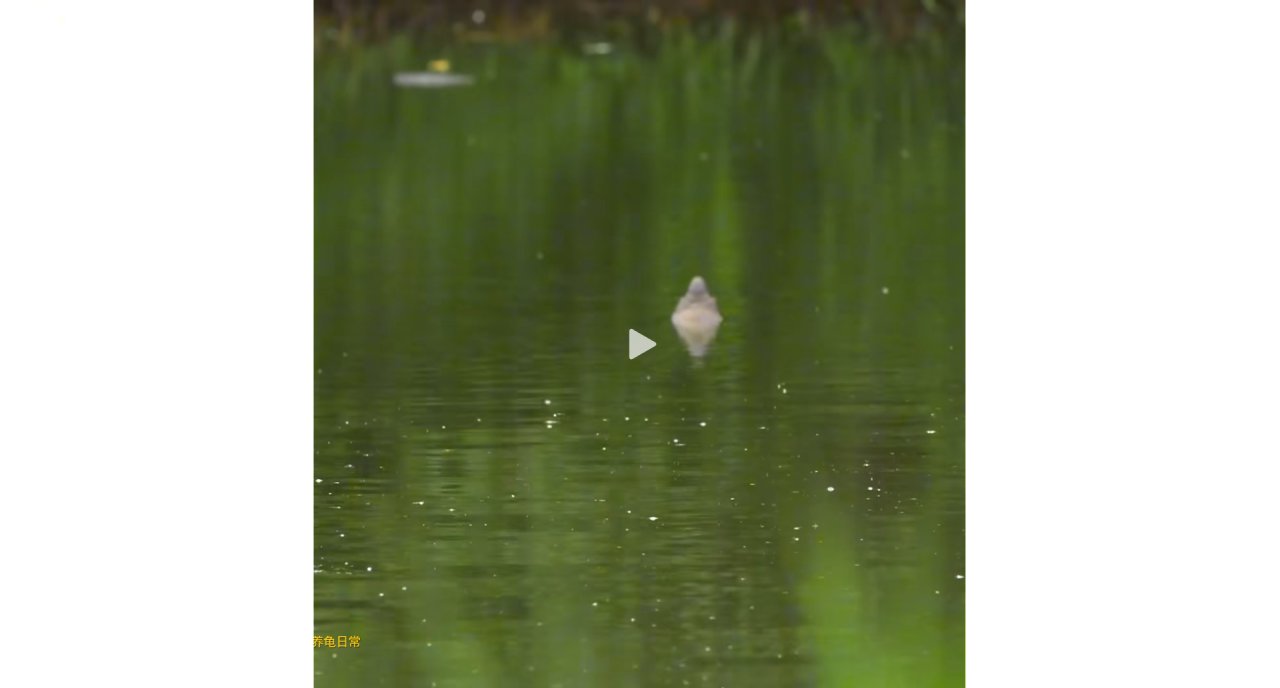
The water in the video was a deep, still green, like old moss soaked into cloth. It wasn’t moving much. Just faint ripples where light hit the surface, breaking up the reflection of trees on the far bank. In the center, barely visible against that dark backdrop, a grayish-brown cone poked out. It looked like a rock at first glance, but then it breathed. A slight rise, a slow fall. This was an alligator snapping turtle (*Macrochelys temminckii*), or as the caption called it, a “Mississippi giant.” It wasn’t swimming. It was waiting. The camera stayed far back, letting the animal remain mostly hidden, just that snout above the line between air and water.
What the Eye Misses
You might think you see the whole animal, but you don’t. The shell is submerged, the body is invisible, and the eyes are likely closed or buried in mud. What we’re seeing is a strategy. These turtles sit motionless for hours, sometimes days, opening their mouths to lure fish with a pink, worm-like tongue. But here, the mouth is shut. The only thing breaking the surface is the nostril area.
This behavior relies on being overlooked. If the water were clear, if the light were bright, the turtle would be spotted. Instead, it uses the murk. The green color isn’t just algae; it’s tannins from decaying leaves, staining the water like tea. That stain hides movement. It hides shape. To the naked eye, even a sharp one, the distinction between a floating branch and a living reptile blurs. The kid watching this on his tablet didn’t know about tannins yet. He just knew the turtle was hiding, and he wanted to know what else was hiding in that green soup.
Opening the Slide
He tapped the screen, not to buy a ticket to a swamp, but to open Wwai. The app didn’t show him the turtle. It showed him what was *in* the water around the turtle. He selected a sample labeled “freshwater sediment.” The AI tutor didn’t lecture him. It asked, “What do you see?” He zoomed in. At first, nothing. Then, tiny dots. Then, shapes. Some
moved. Some didn’t. The tutor explained that these weren’t dirt specks. They were microbes. Bacteria, protozoa, maybe some algae. He couldn’t name them all, and neither could the AI without more data, but he could see them swirling. The turtle’s camouflage worked because it hid its large body. The microbes’ invisibility worked because they were too small to catch the light properly. One scale up, and the world changes completely.
“Is it alive?”
That was his first question. Not “what is it,” but “is it alive.” The tutor paused, processing the ambiguity. “Some are,” it said. “Single-celled organisms. They eat, they move, they reproduce. Others are just particles.” He kept scrolling. He found a cluster of green cells that pulsed slightly under the simulated light. He asked if the turtle ate them. The tutor said no, the turtle eats fish, frogs, carrion. But the microbes eat the dead things the turtle leaves behind. It was a loop he hadn’t seen before. The big monster depends on the tiny cleaners.
Three Questions Parents Ask
When I mention this kind of exploration to parents, three things usually come up. First, “Isn’t this just a toy?” No. It’s a simulation, yes, but it’s built on real specimen data. You won’t get the smell of swamp mud, but you will get the structural truth of what lives there. Second, “Will my kid actually learn anything?” Learning isn’t always memorizing names. Sometimes it’s noticing patterns. Seeing that life exists in layers, from the giant waiting in the water to the microscopic swarm eating the waste, is a conceptual shift. Third, “Is it safe?” There are no chemicals, no broken glass, no risk of infection from handling wild animals. It’s clean science. The mess happens on the screen, not on the kitchen table.
A Different Kind of Waiting
In the comments section of that original video, people argued about keeping the turtle as a pet. “It’s invasive,” someone wrote. “Don’t release it,” another warned. But looking at the footage again, I realized the most interesting part wasn’t the turtle itself. It was the stillness. The way the water held its breath.
We often rush kids through science. Here is the volcano, here is the rocket, here is the answer. But nature doesn’t work that way. It works by waiting. By observing what stays still until it moves. When your child sits with Wwai, zooming into a drop of pond water, they aren’t just playing. They’re practicing the art of noticing. They’re learning that the world is full of things that look like rocks until they breathe.
The turtle sank back down. The water closed over the snout. On the phone, the microbe drifted past the lens.