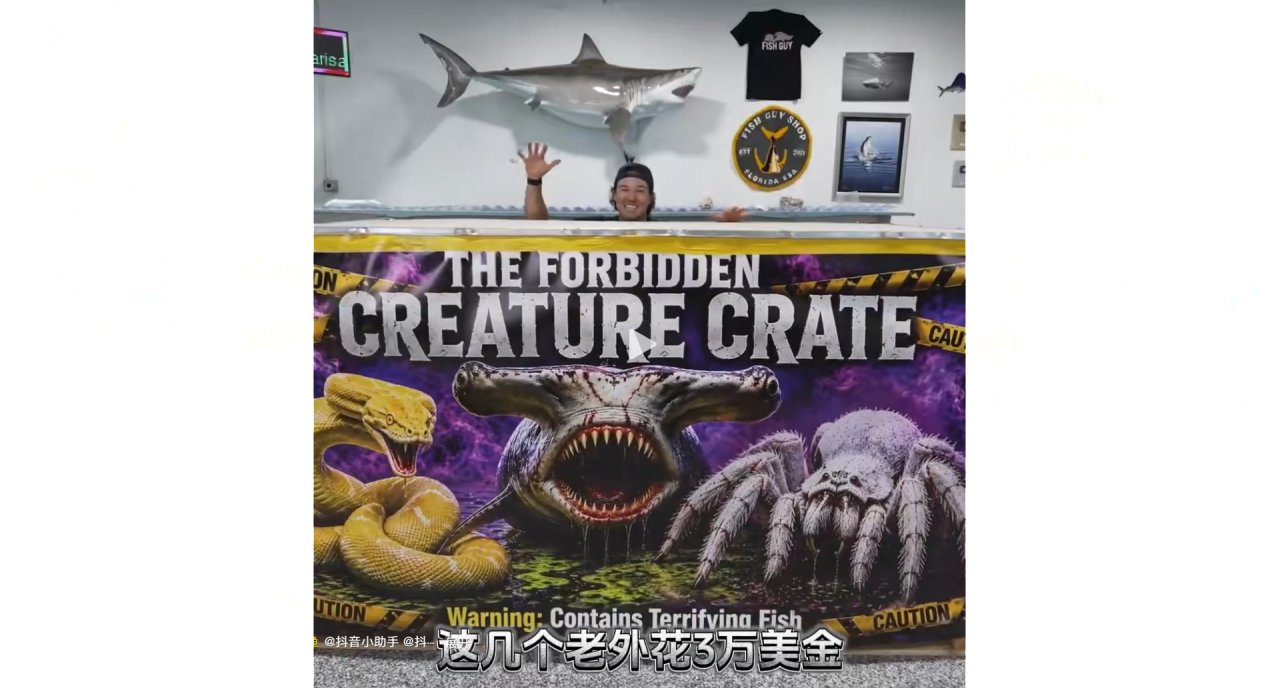
The video pauses on a frame that looks like a stage set for a magic trick. A bright orange background fills the screen, flat and saturated, giving everything a studio-lit feel. In the center sits a dark box with metal corners and yellow-black warning tape on the side. Purple smoke billows out from it, thick and layered, obscuring most of what’s inside. Through the haze, you can barely make out three shapes: a gold-trimmed square box tilted to the left, a blue cylinder lying in the middle, and a metallic panel glowing red on the right. The caption below reads, “Mystery creature unboxing, what creatures are actually inside???” It’s dramatic, loud, and designed to hold attention.
But the comments tell a different story. One user writes, “I'm speechless that this is called a spider.” Another asks, “Isn't this a seafood mystery box?” Then comes the punchline: “This king crab is delicious and edible.” The gap between the theatrical smoke and the mundane reality of dinner is where the curiosity actually lives. We expect monsters; we get meals. The kid watching doesn’t care about the marketing hype. He cares that something hidden behind purple fog turned out to be something he might have eaten last week.
Seeing What Isn’t There
Children process visual information differently than adults do. When an adult sees the smoke, they think “gimmick.” When a child sees it, they think “what’s under there?” This isn’t just patience; it’s a difference in how we filter noise. Adults are trained to look for utility. Kids are still looking for definition. They want to know if the thing behind the curtain is alive, dead, or imaginary. The confusion in the comments—“spider” versus “crab”—shows that even adults struggle to categorize things when the context is manipulated. For a kid, the ambiguity is the point. The reveal matters less than the search.
What it takes | What the kid gets ---|--- Time spent pausing and replaying | Confidence in identifying real organisms Access to a digital library | Ability to distinguish myth from biology No need for physical specimens | Safe exploration of unseen worlds
Wwai as a Quiet Companion
This is where Wwai fits into the evening routine. It’s not about replacing the microscope at school or simulating a lab class. It’s about having a tool that responds to the specific question the kid asked, not the one the video creator intended. The app runs on a phone, using digitized slides and a high-resolution specimen library. No glass breaks. No
