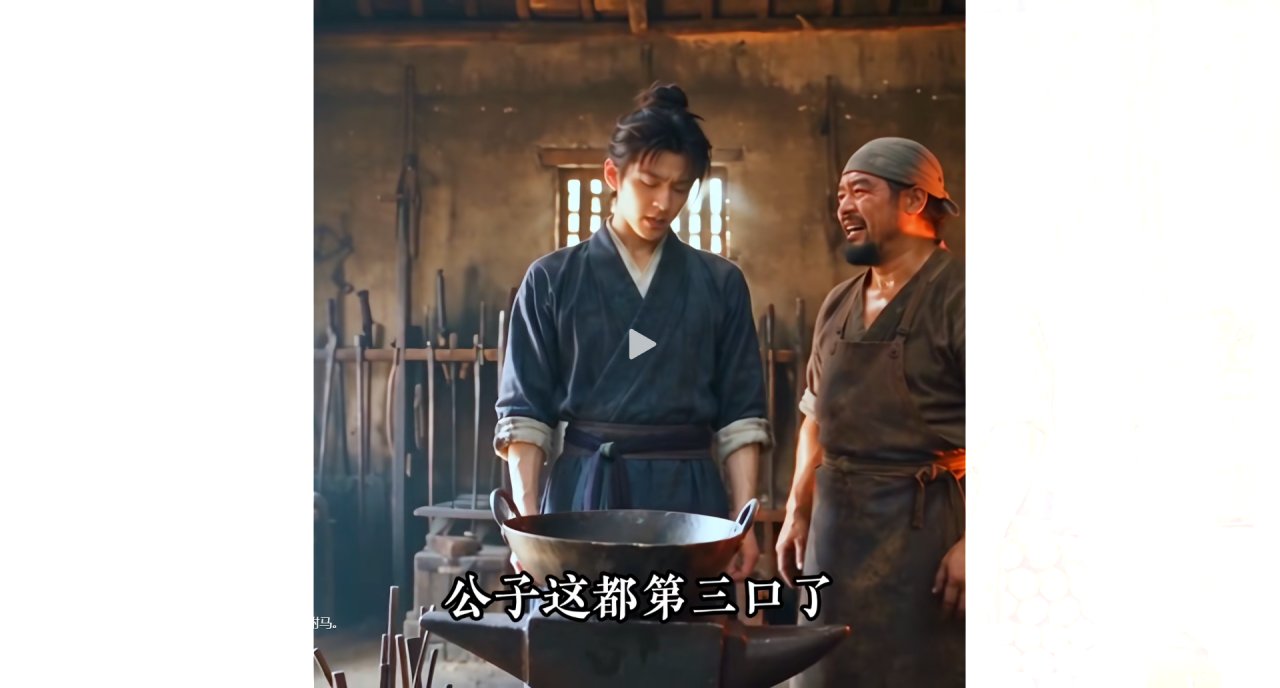
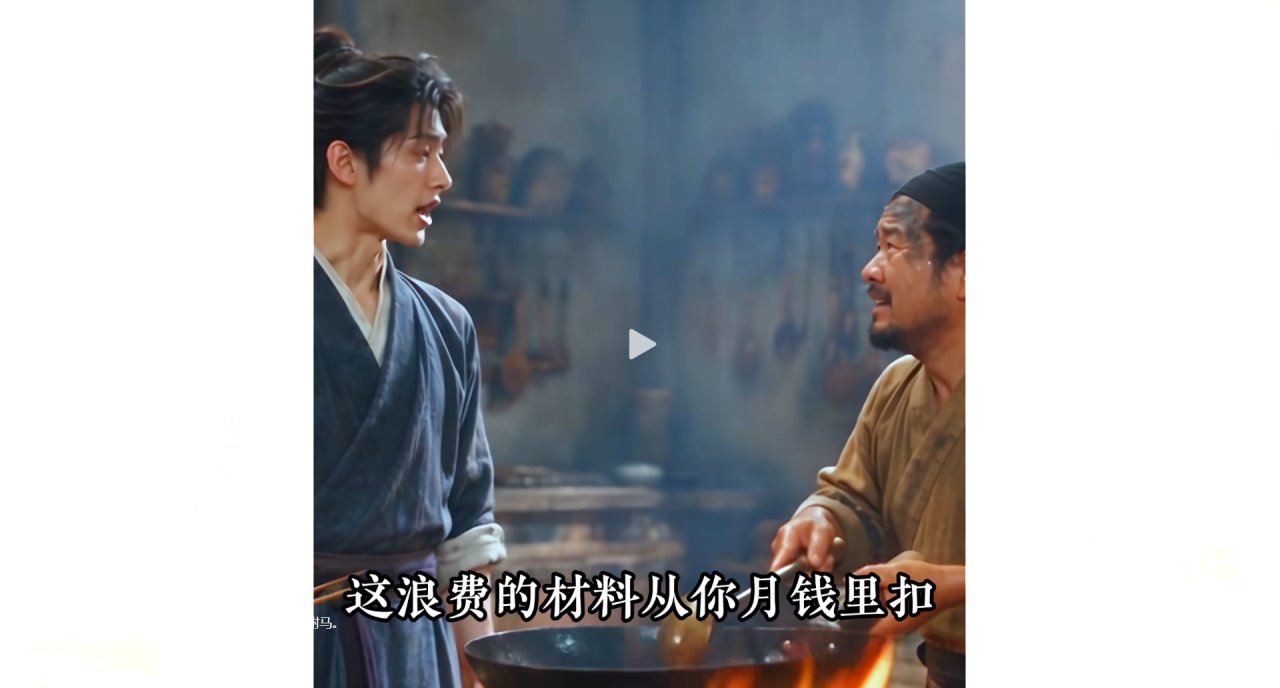
The kitchen is thick with steam and the smell of burning wood. A young man in a dark blue robe stands frozen, a thin wooden skewer still clutched in his hand, his mouth slightly open as if mid-protest. Opposite him, an older cook with sweat glistening on his forehead grips a large ladle, his expression stern.
「This waste of ingredients will be deducted from your monthly pay,」 the subtitle reads. It is a small, sharp conflict over food costs, yet it carries the weight of a larger disruption: a modern soul trapped in an ancient world, trying to survive by cooking.
The Kitchen Standoff
The scene captures a moment of intense tension between two figures in a rustic, brick-walled kitchen. On the left, the younger man’s posture is defensive; he leans back slightly, eyes wide, seemingly arguing that his actions were justified. His sleeves are rolled up, revealing forearms tense with agitation.
On the right, the elder figure dominates the frame. He wears a traditional black cap and earth-toned robes, one hand steadying the heavy iron wok while the other holds the ladle. The fire beneath the wok glows orange, casting warm light against the cool gray smoke of the background. This visual contrast mirrors the clash between tradition and innovation happening in their dialogue.
Tech Meets Tradition
Viewers are quick to point out the historical friction. One comment notes, 「Stir-frying became popular during the Song Dynas...」 highlighting the anachronism of using high-heat wok techniques in the Tang era. Another adds, 「In ancient times, oil was a scarce resource. If...」 suggesting that the very act of stir-frying might be economically impossible for the character.
Yet, this gap between historical reality and dramatic license is part of the appeal. The satisfaction comes from watching a modern mindset navigate ancient constraints. As one user puts it, 「Time-Traveling Ancient Tech Satisfaction」 drives the narrative forward. The protagonist isn’t just cooking; he is introducing a new way of living into an old world.
AI Realism and Audience Reaction
The quality of the visuals has sparked debate about the capabilities of current generative technology. Several comments praise the realism: 「This AI is getting more realistic. It looks way...」 and 「It looks pretty good. Listening to An Ran's aud...」
However, some viewers remain skeptical about the depth of the adaptation. One remark asks, 「Is this 'The Simple Son-in-law of the Zhenguan ...」 indicating that audiences are actively searching for source material to compare against the screen version. The line between original creation and adaptation blurs, creating a unique engagement loop where fans dissect every detail for authenticity.
Identity Clues and Historical Debates
Beyond the kitchen, the plot hints at deeper political stakes. Comments speculate on the true identity of the protagonist, with one asking, 「Could it be possible that he is actually the Cr...」 referring to a crown prince or royal lineage.
Others dive into name etymology, noting, 「Li Gaoming is Li Chengqian's full name; his cou...」 This level of scrutiny shows how invested the audience is in decoding the hidden layers of the story. The simple son-in-law trope is not just about comedy; it is a puzzle box of historical references and power dynamics.
The cost of change