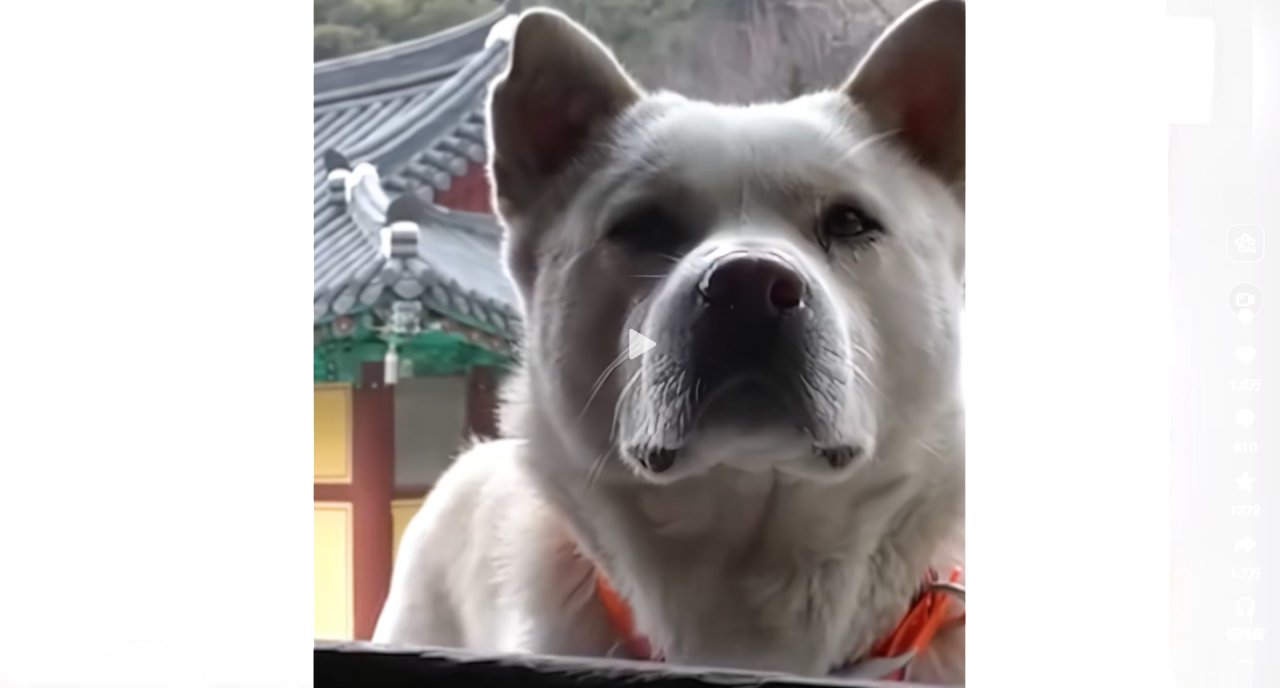
I was scrolling through a video feed one afternoon, half-listening to my kid ask about the bacteria on his hands, when I stopped on a clip that made me laugh out loud. It showed a white dog, looking very much like a Shiba Inu or Jindo mix, walking toward the camera in a traditional temple courtyard. The background was all solemn red pillars and intricate floral carvings, the kind of place where you’re supposed to feel hushed reverence.
But the dog wasn’t reverent. Its eyes were squinted shut, tail held high, moving with a strange, lazy dignity. The caption read, “Five years! Do you know how I’ve spent these five years?” It turned out the dog had been living at the temple for five years, eating vegetarian food alongside the monks. The comments section was a mess of jokes about whether the dog was faking enlightenment or just tired of being filmed, but there was something real in that squint. It looked like a creature that had seen enough of human fussiness to just walk past it, unbothered.
What’s Actually There
That image stuck with me because it mirrored what happens when kids look closely at things they think are simple. We assume a dog is just a dog, or that our hands are just clean after washing. But if you put a swab from your palm under a lens, you’d see a bustling cityscape of microbes. You might spot *Staphylococcus epidermidis*, a common bacterium that lives harmlessly on most human skin. To the naked eye, your hand looks empty. Under magnification, it’s crowded.
The reason we miss this isn’t just resolution; it’s expectation. We don’t expect to see life where we think there’s only surface. The dog in the video didn’t change its behavior for the camera, but the audience projected a whole narrative onto its squint. Science often works the other way around: we have to strip away our projections to see what’s actually there, whether it’s a microbe’s cell wall or a dog’s actual mood.
Not Just a Toy
This is where Wwai comes in. It’s not a replacement for school labs, and it doesn’t promise to turn your kid into a microbiologist overnight. It’s an app that lets them open a simulated microscope on a phone. No glass slides to break, no chemicals to smell. My kid opened it himself, picked a specimen slide from the library, and started poking around. The AI tutor didn’t lecture; it just walked him through what he was seeing, step by step. When he asked why some blobs moved faster than others, the tutor gave a plain answer about flagella, then admitted it didn’t know every species on sight. He checked the conclusion himself, zooming in again.
Three Things Parents Ask
“Is this cheating on science class?” No. School teaches theory; this teaches observation. A textbook says bacteria exist. This lets a kid see the shape of a rod versus a sphere. It’s practice, not a shortcut.
“What if they get bored?” They might. That’s fine. The app doesn’t force progression. If they spend ten minutes staring at pond water and then quit, they still saw something real. Curiosity isn’t a straight line.
“Does it work without Wi-Fi?” The core library is downloaded once. After that, it runs offline. You can take it to a park or a relative’s house with bad signal, and the specimens stay sharp.
A Different Kind of Focus
There’s a difference between watching a viral video of a funny dog and understanding why the dog acts that way. One is entertainment; the other is inquiry. Both have value. But inquiry requires slowing down. It means looking at the squint and asking, “What does that muscle movement mean?” rather than just laughing at the caption.
My kid tried swiping his finger across a table surface before using the app’s simulation. He expected dirt. He got a gray smear of particles and fibers. “It’s not just dust,” he said. “It’s stuff.”
We don’t need to raise another generation of people who can recite facts about microbes. We need more people willing to look closer at the messy, unglamorous reality right in front of them, even if it’s just a hand or a temple floor. The dog kept walking, tail up, eyes closed, heading somewhere we couldn’t see.