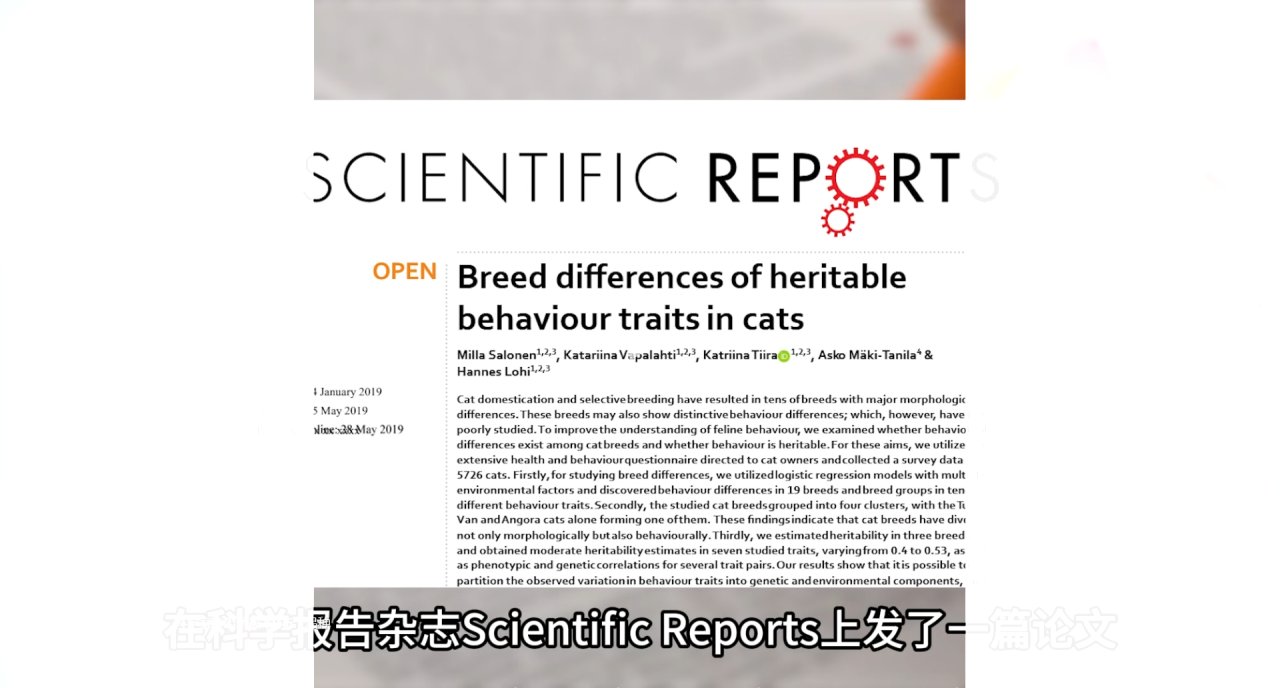
A 2019 study on cat behavior sparks debate in a comment section
Published: November 18, 2026 author: Meka
The screen shows a white paper from *Scientific Reports*, the journal’s logo featuring red interlocking gears. The title reads “Breed differences of heritable behaviour traits in cats.” Below it, a list of authors and dates: received January 24, 2019; published May 28, 2019. In the blurred background, an orange shape suggests a cat’s ear or paw, softening the rigid academic layout.
This is episode 140 of a series titled “After surveying 5,726 cats, scientists picked the 5 most well-behaved breeds.” The caption at the bottom states plainly, “Published a paper in *Scientific Reports*.” It’s a moment where hard data meets the messy reality of pet ownership. The video isn’t just sharing facts; it’s holding up a mirror to how we interpret them. The search bar in the corner asks for “Birman cat,” hinting that viewers are already looking for themselves in these numbers.
What the comments reveal
Scroll down, and the certainty of the study dissolves into personal experience. One user insists, “British Shorthairs are indeed the most well-behaved,” while another counters, “Actually, long-haired ones are more well-behaved.” There’s skepticism about aggression levels in Ragdolls and jokes about shedding. Someone mentions seeing a stray Abyssinian, complicating the neat categories of breed purity.
These reactions aren’t noise; they’re data points too. They show that parents and owners don’t read science as a final verdict but as a starting point for their own observations. When a kid sees a cat jump off a table, does it matter if the study says the breed is docile? The gap between the abstract number and the living animal is where curiosity lives. Adults often try to close that gap with authority. Kids tend to widen it with questions.
The question chain
A child watching this might ask, “Why do some cats have stripes?” Then, “Do stripes make them meaner?” And finally, “Can I see what makes fur different under a lens?” These questions don’t follow a textbook order. They bounce from appearance to behavior to structure. The first question is easy enough. The second invites speculation. The third requires tools you likely don’t have in the kitchen drawer.
That last question is the pivot. It moves from talking about cats to looking at biology. You can explain inheritance with charts, but you can’t explain the texture of a hair shaft without showing it. This is where the conversation usually stalls for families without lab equipment. The desire to look closer hits a wall of practicality.
Seeing the invisible
We talk about “breed” as if it’s a fixed label, like a name tag. But biologically, it’s a collection of small variations. Take a single strand of cat hair. To the naked eye, it’s just a thin line. Under magnification, it reveals scales, pigment distribution, and structural integrity. These microscopic features influence how light reflects off the coat, which affects color perception, and how the hair breaks, which relates to shedding.
You won’t find a gene for “well-behaved” written on a hair shaft. Behavior is complex, influenced by environment and individual history. But the physical traits—fur type, body structure—are visible. Understanding that difference helps separate what we can measure from what we guess. Science often deals in probabilities, not certainties. A study of 5,726 cats gives us trends, not rules for your specific pet.
What it takes
What it takes
What the kid gets
A few minutes of focused attention
A visual anchor for abstract concepts
Willingness to say “I don’t know”
Permission to ask better questions
Access to a digital simulation
A safe space to test hypotheses
Wwai in the middle
This is where Wwai fits into the afternoon routine. It’s not a replacement for a real microscope, nor does it promise to teach genetics in an hour. Instead, it offers a simulated view. A kid opens the app, selects a specimen slide, and the AI tutor walks them through what’s on screen. If the child asks, “Why is this fuzzy?” the tutor explains the structure, then pauses, letting the kid check the conclusion against their own eyes.
The interface is simple. No glassware to break, no chemicals to handle. Just high-resolution images of everyday things—like a drop of pond water or a piece of fabric. The tutor doesn’t claim omniscience. Sometimes it says, “That’s a good question, let’s look closer.” It keeps the inquiry going rather than ending it with a fact sheet. For a family in a suburb without a natural history museum nearby, this provides a window into the unseen world.
A quiet observation
Try looking at your hands after playing with a cat. Not for dirt, but for context. Use a magnifying glass if you have one. You might see tiny fibers, skin cells, or dust mites. This isn’t about hygiene fear; it’s about scale. It connects the large animal you love to the microscopic reality that surrounds it. The cat sheds. The dust settles. The cycle is visible if you look closely enough.
Science isn’t always about big discoveries. Often, it’s about noticing the small things that were always there. The study on cats didn’t change what a British Shorthair looks like. It changed how people talked about it. And maybe, just maybe, it sparked a question that led someone to look deeper.
The orange blur in the background of the screenshot remains out of focus. The cat is still there, moving independently of the data.