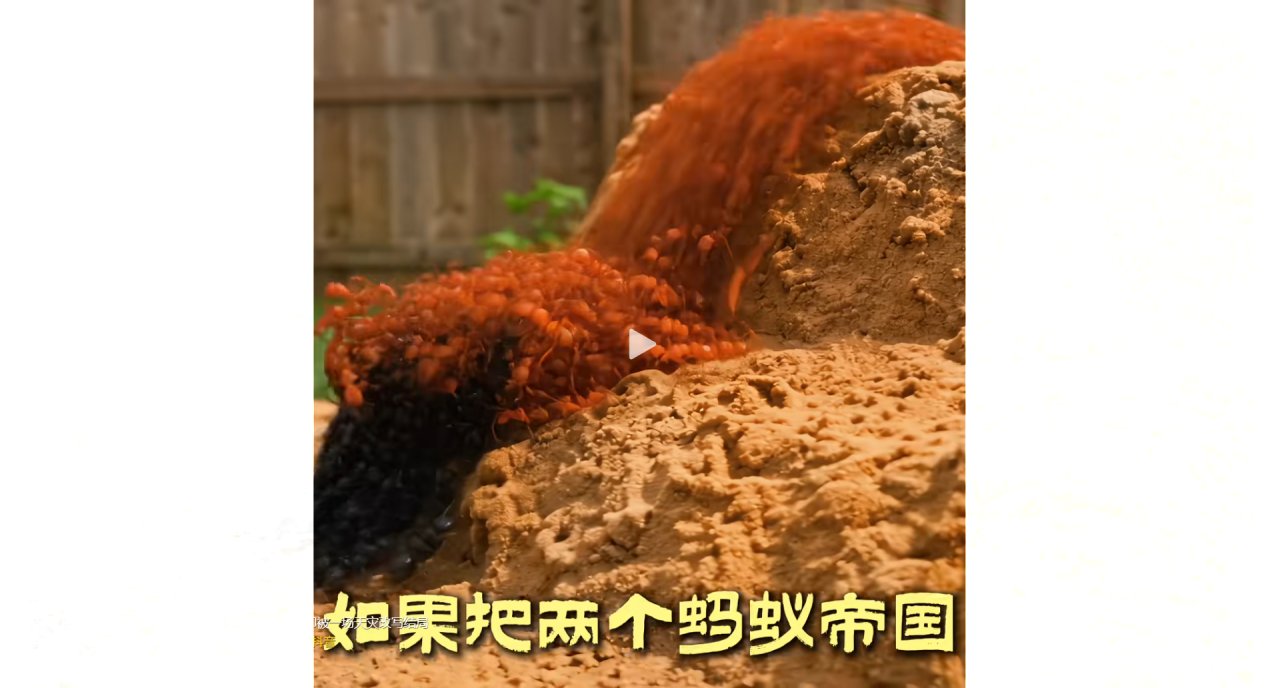
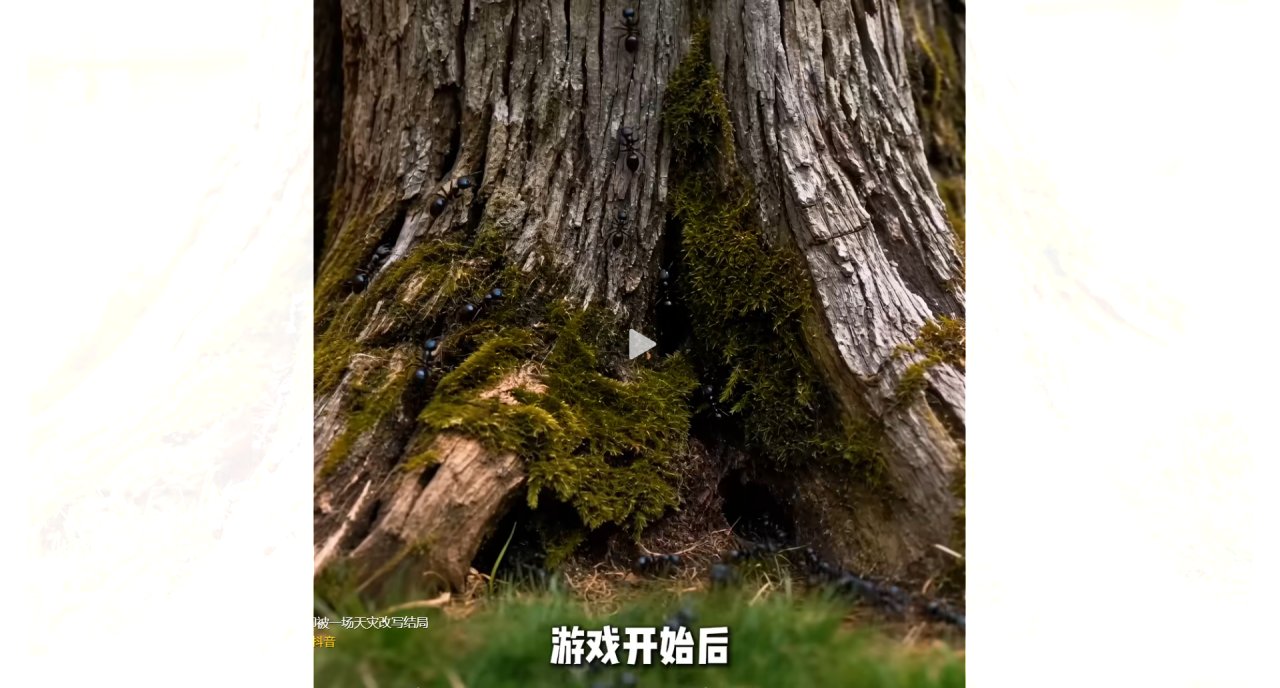
The screenshot is quiet, almost too still for a video paused at 12:04. A thick tree trunk dominates the center, its gray-brown bark split by deep vertical grooves that look like dried riverbeds. Clumps of vivid green moss cling to the crevices, soft and dense against the rough wood. Scattered across this landscape are black ants, their shells catching the light with an oily sheen. Some climb the texture of the bark; others wind along the edge of the moss. Near the root base, a cluster gathers around a dark hole, moving in what looks like a patrol. The background is a blur of green grass, keeping the focus locked on this small triangle of life. It feels orderly, peaceful even. But the caption below reads “Game Start,” hinting that this calm is just the breath before chaos.
What the Eye Misses
We see ants as individual dots, busy but disconnected. The naked eye cannot resolve the chemical trails they lay down, nor the pheromone signals that coordinate their movements from dozens of feet away. In the video, the “disaster” mentioned in the title isn’t visible yet. It’s likely rain or a disturbance that will scatter the colony. Without magnification, we miss the structural integrity of the nest entrance, the way the soil particles are packed by saliva and waste to create waterproof tunnels. We see movement; we don’t see the architecture holding it together. The tension in the frame comes from what we know is coming but cannot see happening in real time at this scale.
Three Doubts, Three Answers
Parents often pause here. One comment asks, *“How do they communicate with each other?”* It’s not speech. It’s touch and smell. Antennae tap bodies; chemicals linger on surfaces. Another parent worries about safety, noting *“Red ants have already occupied Guangdong.”* This is valid. Fire ants
(*Solenopsis invicta*) are aggressive and painful. But the black ants in this frame are likely native species, less prone to unprovoked attacks. A third hesitation is simpler: *“Clearly a city slicker [doesn't get this].”* Rural kids might spot these patterns faster, but curiosity isn’t geographic. The screen bridges the gap. You don’t need a backyard to understand the logic of a swarm.
Looking Closer Without Risk
Wwai steps into this space where observation meets explanation. The kid opens the app himself, no glass slides to break, no chemicals to handle. He selects a specimen slide that mirrors the scene in the video—a close-up of ant anatomy or soil structure. The AI tutor walks him through what he sees. If he asks why the ants group near the root, the tutor explains the humidity gradient or the food source proximity. If the answer is complex, the tutor admits it and suggests a next step. The kid checks the conclusion, maybe zooming in further or switching views. It’s a loop of question and verification, not a lecture.
The Cost of Curiosity
What it takes
What the kid gets
Ten minutes of focused attention
A mental model of invisible systems
Willingness to say “I don’t know”
Confidence in asking better questions
No special equipment or field trips
Access to a world usually hidden
This isn’t about grades. It’s about noticing. When you watch a video and see only bugs, you miss the empire. When you look closer, you see the strategy, the vulnerability, the sudden end caused by a drop of water. The app doesn’t replace the dirt under your fingernails, but it lets you see what the dirt hides.
A Quiet Shift
There’s a moment when the child stops looking at the screen as a game and starts seeing it as a place. He points at the moss in the simulation and asks if it’s alive. He compares the digital ant to the one outside the window. The distance between the two shrinks. He realizes that the tiny things have big rules. And sometimes, those rules change everything.
The video ends with the ants scattering. The frame goes dark. The question remains.